AWS vs Azure vs Google Cloud for Modern Web Apps: An Engineering Architecture Comparison
A developer-first architectural evaluation of AWS, Microsoft Azure, and Google Cloud Platform (GCP) for containerized web apps, databases, developer ergonomics, and networking costs.
The Serviceverse Engineering Team
Cloud Architecture & DevOps
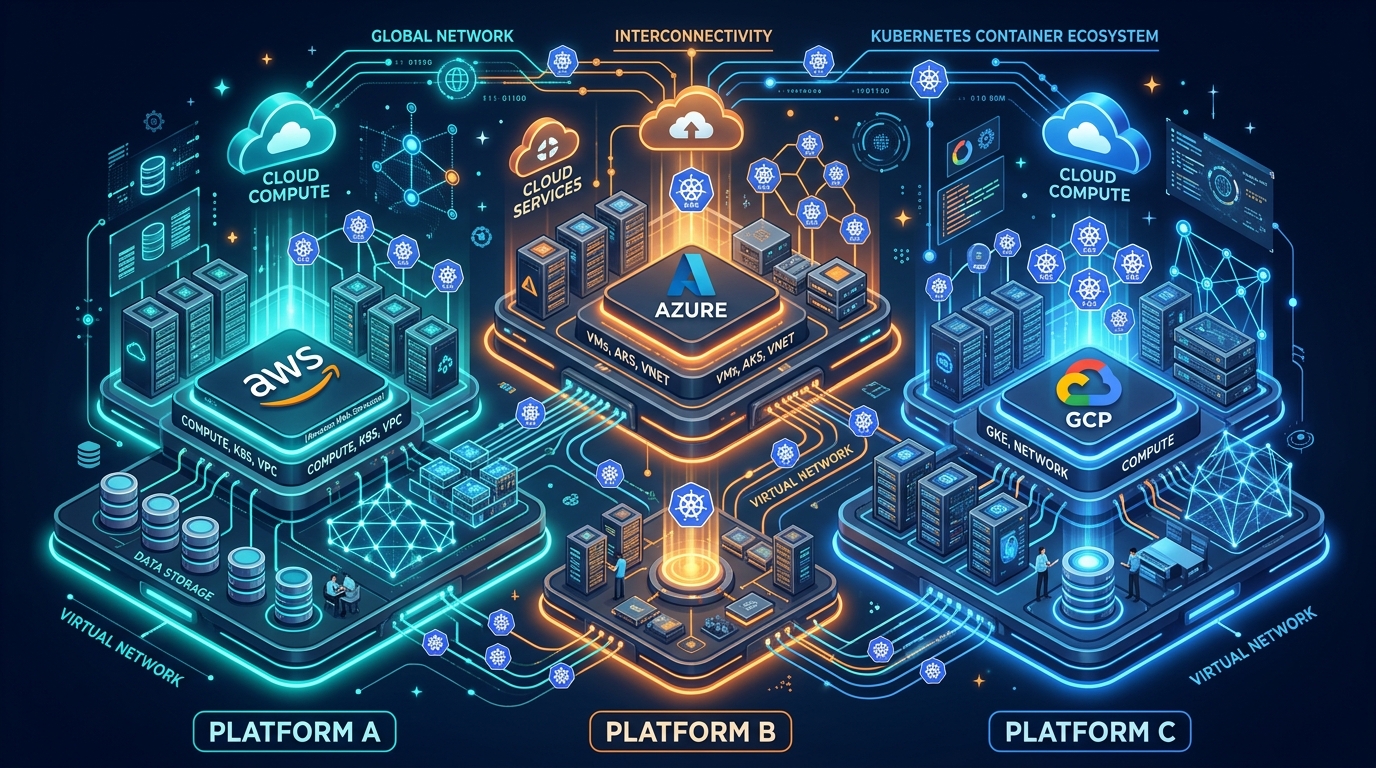
Choosing a cloud hyperscaler is one of the most consequential decisions an engineering team makes. Sales teams and cloud executives often frame the choice around promotional startup credits or enterprise bundling discounts. However, once your team builds its infrastructure and your customer traffic grows, the real cost of the platform is dictated by developer velocity, operational complexity, and architectural ergonomics.
AWS, Microsoft Azure, and Google Cloud Platform (GCP) are all capable of hosting enterprise web applications at scale. Yet each platform reflects a fundamentally different engineering heritage.
This architectural guide breaks down how AWS, Azure, and GCP compare across the core building blocks of modern web engineering: container runtimes, managed databases, developer tooling, and networking costs.
---
1. The Heritage and Philosophy of the Big Three
Understanding each provider’s core DNA explains their operational strengths and frustrations:
- Amazon Web Services (AWS): The pioneer and breadth leader. AWS approaches cloud infrastructure like a vast hardware supply chain: every primitive component (networking, block storage, IAM, queuing) is exposed as an independent service with granular permissions. It offers unmatched service breadth, but assembling an application requires significant DevOps configuration.
- Microsoft Azure: The enterprise ecosystem champion. Azure is designed to seamlessly extend corporate Active Directory (Entra ID), Windows Server, Office 365, and enterprise security policies. It excels in hybrid-cloud deployments and enterprise procurement, though its management consoles and CLI tooling often carry enterprise legacy friction.
- Google Cloud Platform (GCP): The developer-ergonomics and data systems leader. GCP builds on Google’s internal infrastructure innovations (Borg/Kubernetes, BigQuery, global fiber backbones). Its APIs are cohesive, IAM is straightforward, and its container and machine learning abstractions are among the cleanest in the industry.
+-----------------------------------------------------------------------------------------+
|                               CLOUD EVALUATION MATRIX                                   |
+---------------------+-------------------------+--------------------+--------------------+
| Dimension           | AWS                     | Microsoft Azure    | Google Cloud (GCP) |
+---------------------+-------------------------+--------------------+--------------------+
| Container Runtime   | ECS (Fargate) & EKS     | Container Apps & AKS | Cloud Run & GKE    |
| Managed Relational  | RDS / Aurora PostgreSQL | Azure Database / SQL | Cloud SQL / Spanner|
| Global Networking   | Regional Edge / Global  | Front Door / VNet  | Global Anycast IP  |
| Developer Tooling   | AWS CLI, CDK, Terraform | Azure CLI, Bicep   | gcloud, Terraform  |
| Enterprise Identity | AWS IAM, Identity Center| Microsoft Entra ID | Google Cloud IAM   |
+---------------------+-------------------------+--------------------+--------------------+
---
2. Container Orchestration: ECS vs. Container Apps vs. Cloud Run & GKE
For modern web applications, virtual machines (EC2, Azure VMs, Compute Engine) are rarely the primary deployment target. Modern engineering teams run containerized microservices:
Google Cloud Run: The Standard for Serverless Containers
For standard stateless web applications and APIs, Google Cloud Run offers an exceptional developer experience:
- Deploys any standard Docker container in seconds.
- Scales to zero seamlessly with fast cold-start performance (<1.5 seconds for lightweight Go/Node runtimes).
- Fully managed HTTP routing, automatic TLS provisioning, and zero cluster control-plane management fees.
AWS ECS with Fargate: Pragmatic Simplicity for Complex Topologies
AWS offers Elastic Container Service (ECS) alongside Kubernetes (EKS). ECS avoids the cognitive overhead of Kubernetes manifests while providing robust VPC networking, service discovery (AWS Cloud Map), and seamless task execution via AWS Fargate. It is predictable, battle-tested, and significantly simpler to maintain than self-hosted Kubernetes.
Azure Container Apps: Kubernetes Power Behind a Serverless Facade
Built on top of AKS and KEDA (Kubernetes Event-driven Autoscaling), Azure Container Apps provides microservices capabilities (Dapr sidecars, background job scaling, traffic splitting) without exposing full Kubernetes control planes. While powerful, troubleshooting underlying KEDA scaling events can occasionally be opaque.
---
3. Managed Relational & Distributed Databases
The operational heart of any business software system is its database layer:
| Hyperscaler | Flagship Relational Engine | Strengths | Operational Considerations |
|---|---|---|---|
| AWS | Amazon Aurora (PostgreSQL/MySQL) | Storage auto-scaling up to 128TB, sub-second replica lag, exceptional read-replica scaling. | Can become extremely expensive if I/O-intensive queries are not optimized (consider Aurora I/O-Optimized tier). |
| Microsoft Azure | Azure SQL Database & Azure PostgreSQL Flexible Server | Deep integration with Microsoft tools, automated performance tuning, serverless pause/resume. | Provisioned IOPS tiers can experience thermal throttling if workload bursts are misconfigured. |
| Google Cloud | Cloud SQL & AlloyDB / Cloud Spanner | AlloyDB delivers up to 4x transactional throughput of standard PostgreSQL; Spanner provides true global ACID consistency. | Cloud Spanner requires specialized relational schema modeling to prevent hotspotting. |
Engineering Recommendation: For 95% of web platforms, standard managed PostgreSQL (AWS RDS PostgreSQL, Azure Flexible Server, or GCP Cloud SQL) running high-availability Multi-AZ replication is substantially more cost-effective and portable than proprietary cloud-native database engines.
---
4. Developer Velocity and Infrastructure as Code (IaC)
A platform that requires 40 clicks across three legacy portals to provision an SSL certificate slows down engineering cycles:
- GCP’s Unified Resource Hierarchy: GCP organizes infrastructure cleanly:
Organization -> Folders -> Projects. Switching environments (Development, Staging, Production) is as simple as switching project IDs in the CLI. IAM permissions inherit cleanly down the resource tree. - AWS CDK and Terraform Maturity: Because AWS is the industry incumbent, third-party tooling, open-source Terraform modules, and GitHub Actions integrations are exceptionally mature. The AWS Cloud Development Kit (CDK) allows developers to define infrastructure using TypeScript or Python, bridging the gap between application engineers and DevOps.
- Azure Bicep and Identity Integration: Azure Bicep has replaced clumsy ARM JSON templates, offering clean syntax comparable to Terraform. For organizations already running Microsoft Entra ID (Azure AD), granting developer permissions based on corporate groups is seamless.
---
5. The Egress Cost and Networking Trap
While cloud computing is often evaluated on compute (vCPU/RAM per hour), networking and data egress fees represent one of the most common budget surprises:
- Inter-Region Data Egress: Transferring data between cloud regions (e.g.,
us-east-1toeu-central-1) costs $0.02 – $0.09 per GB across all major providers. - Cross-Availability Zone (AZ) Traffic: Replicating databases or calling microservices across availability zones within the same cloud region incurs a quiet $0.01/GB transfer fee each way. At high data throughput (e.g., streaming video frames or tick-data logs), inter-AZ fees can exceed the cost of the virtual machines themselves.
- Public Egress Pricing: Streaming assets to public users directly from virtual machines is cost-prohibitive. All architectures must route static and media assets through a Content Delivery Network (CloudFront, Azure Front Door, or Cloudflare) to benefit from compressed edge caching rates.
---
6. Decision Framework: Which Cloud Fits Your Workload?
Choose AWS if:
  ├── You require niche managed services (e.g., specific hardware instances, specialized brokers).
  ├── Your engineering team has deep Terraform or AWS CDK expertise.
  └── You need access to the broadest third-party SaaS ecosystem and integration connectors.

Choose Azure if:
  ├── Your company is deeply invested in Microsoft 365, Active Directory, and C# / .NET ecosystems.
  ├── Enterprise procurement mandates Microsoft enterprise agreements.
  └── You require hybrid-cloud integration with on-premises Windows Server data centers.

Choose Google Cloud (GCP) if:
  ├── Your primary application runtime is container-based (Cloud Run or GKE).
  ├── Your platform relies heavily on BigQuery, real-time analytics, or large-scale AI/ML pipelines.
  └── You prioritize clean developer ergonomics, fast CLI tooling, and simple project-based IAM.
---
7. When Multi-Cloud Is an Over-Engineered Mistake
Many teams declare an ambition to build a "multi-cloud" architecture to avoid vendor lock-in. In practice, building an abstraction layer capable of running seamlessly across AWS, Azure, and GCP simultaneously:
- Doubles DevOps operational overhead.
- Introduces high cross-cloud egress latency and bandwidth charges.
- Restricts your engineering team to the lowest common denominator of cloud capabilities, preventing you from leveraging managed databases or serverless queues effectively.
Pragmatic Strategy: Pick the single cloud hyperscaler that aligns with your team's technical skills and compliance requirements. Build your applications using standard container images (Docker), standard relational databases (PostgreSQL), and cloud-agnostic Infrastructure as Code (Terraform/OpenTofu). You will retain 90% of architectural portability with none of the multi-cloud operational tax.
---
8. How The Serviceverse Architects Cloud Solutions
The Serviceverse builds resilient, cost-efficient cloud infrastructure designed for long-term operational health:
- Cloud-Native Web Development: We engineer fast, secure web applications on modern serverless and container architectures (Web Development Services).
- Custom Backend & API Engineering: We design robust microservices, message queues, and database architectures optimized for reliability and low latency (API & Backend Development).
- Infrastructure Automation: We implement automated CI/CD pipelines, container orchestration, and Infrastructure as Code to ensure reproducible deployments (Custom Software Engineering).
Evaluating your cloud architecture or planning a migration? Contact our cloud engineering team at info@theserviceverse.com or connect on WhatsApp at +91 7091021058.
Planning a Software, AI, or Data Initiative?
The Serviceverse helps engineering and product teams design scalable software architectures, train production computer vision models, and automate mission-critical operations.
Related Capabilities