Bottleneck-First Digital Transformation: Prioritising Custom Software Where It Truly Moves the Needle
How to avoid tool-driven digital transformation traps by applying the Theory of Constraints to software investment: identifying operational bottlenecks and knowing when to build vs buy.
The Serviceverse Engineering Team
Enterprise Systems Strategy
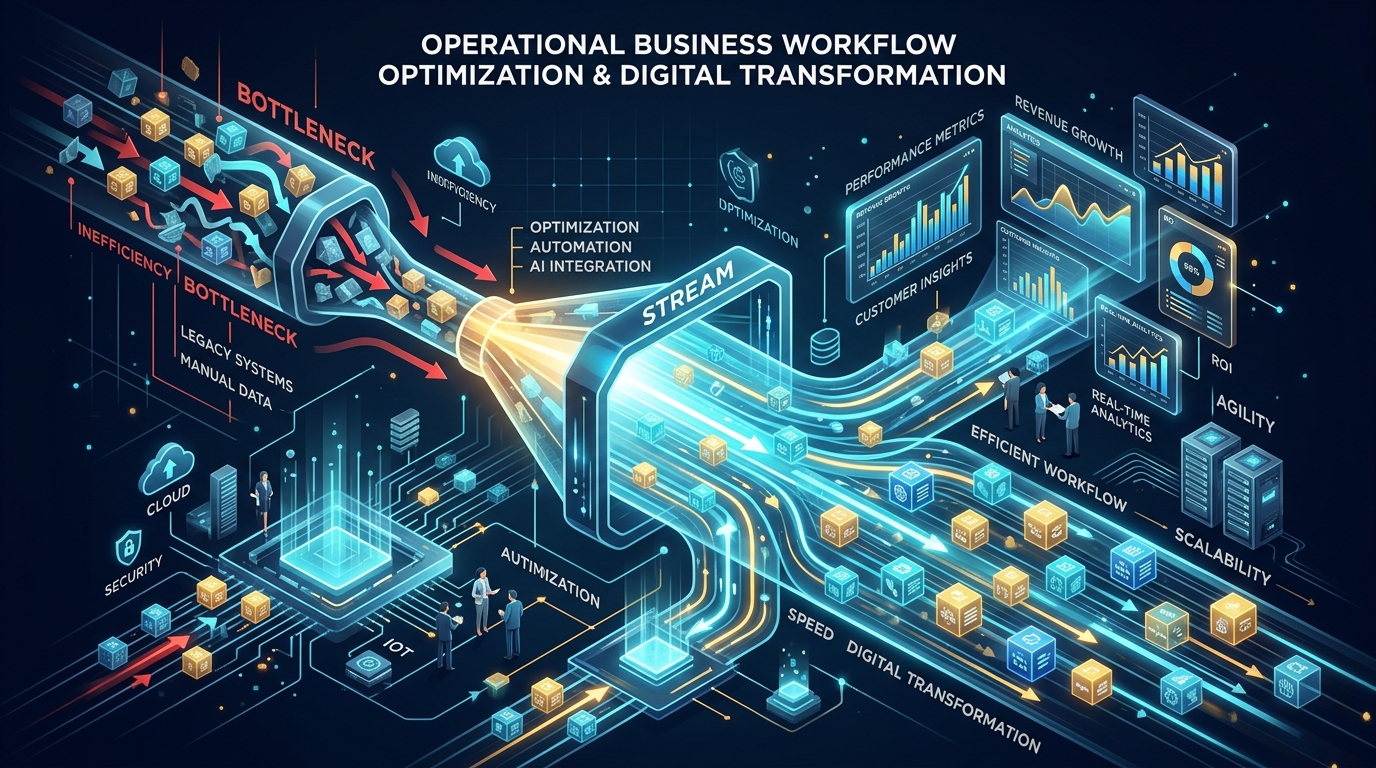
"Digital transformation" is one of the most overused phrases in modern business. All too often, it translates to purchasing expensive off-the-shelf enterprise SaaS subscriptions, introducing half a dozen new communication tools, and organizing steering committees that produce lengthy slide decks.
Two years later, executive leadership discovers an uncomfortable reality: despite spending hundreds of thousands of dollars on software licenses, operational throughput has barely budged. Employees maintain shadow Excel spreadsheets to bypass the new tools, and the primary business bottlenecks remain completely unresolved.
True digital transformation is not about adopting technology for its own sake. It is about identifying the single most restrictive constraint in your operational workflow and engineering software specifically designed to break that constraint.
---
1. The Theory of Constraints Applied to Business Software
Formulated by Dr. Eliyahu Goldratt in manufacturing, the Theory of Constraints (TOC) asserts a fundamental operational law:
Consider an industrial distribution company:
- If sales reps take 48 hours to manually price quotes because pricing rules are trapped in disconnected spreadsheets, buying a modern marketing automation tool will not increase revenue. It will simply funnel more leads into an already choked quotation queue.
- If warehouse dispatch is limited by manual physical barcode verification, redesigning the customer mobile app will not improve delivery speed.
+-------------------------------------------------------------------------+
|                  THE BOTTLENECK TRANSFORMATION CYCLE                    |
+-------------------------------------------------------------------------+
                                    |
                                    v
     [ 1. IDENTIFY ]  ---> Find the single slowest hand-off in the business
                                    |
                                    v
     [ 2. EXPLOIT ]   ---> Maximize throughput of the constraint right now
                                    |
                                    v
     [ 3. SUBORDINATE]---> Align upstream and downstream software to pace
                                    |
                                    v
     [ 4. ELEVATE ]   ---> Engineer custom software to automate the constraint
                                    |
                                    v
     [ 5. REPEAT ]    ---> Find the next bottleneck. Never allow inertia.
---
2. Conducting an Operational Bottleneck Audit
Before writing a Request for Proposal (RFP) or writing code, map your business processes from initial customer inquiry to cash collection:
Metrics to Measure:
- Cycle Time (Lead Time): The total calendar time it takes for a work item (lead, quote, order, ticket) to move from inception to completion.
- Touch Time: The actual minutes an employee spends actively working on the task.
- Queue Time (Wait Time): The time the work item sits idle in an inbox, awaiting review, approval, or data transfer.
In most un-automated enterprises, touch time accounts for less than 5% of total cycle time. The remaining 95% is pure queue waste: waiting for a manager's signature, waiting for someone to manually re-type an invoice from an email into an accounting portal, or waiting for inventory confirmation.
Targeting software to eliminate queue waste delivers dramatic return on investment compared to marginal optimizations in touch time.
---
3. The Build vs. Buy Matrix
A central failure of digital initiatives is attempting to build custom software for commodity processes, while buying off-the-shelf software for core differentiating operations:
| Category | Examples | Recommendation | Rationale |
|---|---|---|---|
| Commodity / Standardized | Payroll, General Ledger, Corporate Email, Video Calls | BUY (SaaS) | Off-the-shelf tools (e.g., Gusto, QuickBooks, Google Workspace) are mature, compliant, and cost-effective. Custom engineering provides zero competitive edge. |
| Operational Parity | Standard Support Helpdesk, Basic CRM Pipeline | BUY & CONFIGURE | Standard tools (e.g., Zendesk, HubSpot) suffice if your sales/support motions follow conventional industry patterns. |
| Differentiating Core Workflow | Proprietary Pricing Engines, Real-Time Fleet Dispatch, Specialized AI Data Processing | BUILD (Custom Software) | Commercial SaaS forces your team to contort unique operational advantages to fit generic database tables. Custom software creates an uncopyable operational barrier to entry. |
High Competitive Advantage
        ^
        |     [ CONFIGURE & EXTEND ]          [ BUILD CUSTOM ]
        |     Extend commercial CRM          Proprietary trading engine,
        |     with custom webhooks           custom manufacturing scheduling
        |
        |     [ BUY OFF-THE-SHELF ]          [ CONFIGURE BASIC ]
        |     Standard payroll,              Basic support ticketing,
        |     corporate email                standard lead capture forms
        +--------------------------------------------------------->
       Low                                                       High
                         Operational Complexity
---
4. Phased Implementation: Delivering Incremental Value
Avoid the trap of the multi-year monolithic enterprise rollout. Large enterprise software projects that do not deliver a working software release within 90 days are prone to scope creep and loss of organizational trust.
The 90-Day High-Impact Cycle:
- Days 1–15: Workflow Mapping & Constraint Agreement: Map the exact hand-offs of the single biggest bottleneck with the operators who actually do the work.
- Days 16–45: Minimum Viable Automation (Sprint 1): Build the core automated data bridge or web portal. Focus exclusively on eliminating manual double-entry.
- Days 46–60: Shadow Testing & User Feedback: Run the new system alongside existing processes with a small, receptive pilot group of operators.
- Days 61–90: Production Cutover & Metrics Measurement: Cut over the pilot group completely. Measure cycle time reduction and quantify labor hours redirected to value-additive tasks.
---
5. Change Management: Software People Actually Use
The most architecturally elegant software system is worthless if end users actively resist adopting it. User resistance is rarely caused by stubbornness; it is usually a rational response to poorly designed user experiences that require more clicks and data entry than the legacy spreadsheet it replaced.
- Design from the Operator's Task Outward: Prioritize keyboard shortcuts, auto-filled fields, and mobile responsiveness for field personnel (UI/UX Design Services).
- Provide Instant Feedback: When an employee submits a form, display immediate confirmation and clear status tracking rather than a generic loading spinner.
- Involve Operators Early: Invite line supervisors and operations staff into demo sprints every two weeks. When people participate in shaping a tool, they champion its rollout across their teams.
---
6. How The Serviceverse Delivers Bottleneck-First Software
The Serviceverse partners with growing businesses to engineer custom software that directly addresses core operational bottlenecks:
- Tailored Enterprise Software: We build custom web applications, workflow automation tools, and internal portals shaped around your exact operational workflows (Custom Software Development).
- Connected ERP & CRM Systems: We eliminate manual double-entry by designing interconnected platforms that bridge sales, inventory, and back-office accounting (ERP Development & CRM Development).
- User-Centered Interface Design: We design dense, intuitive expert interfaces that operators love using from day one (UI/UX Design Services).
Ready to identify your operational bottlenecks and build software that moves the needle? Connect with our systems architects at info@theserviceverse.com or message us on WhatsApp at +91 7091021058.
Planning a Software, AI, or Data Initiative?
The Serviceverse helps engineering and product teams design scalable software architectures, train production computer vision models, and automate mission-critical operations.
Related Capabilities