
An Engineering Feasibility Matrix for AI: Evaluating ROI, Data Readiness, and Technical Risk Before Building
A rigorous engineering feasibility scorecard to evaluate AI projects before writing code: task determinism, ground-truth data readiness, inference costs, and human fallback.
The Serviceverse Engineering Team
AI & Machine Learning Engineering
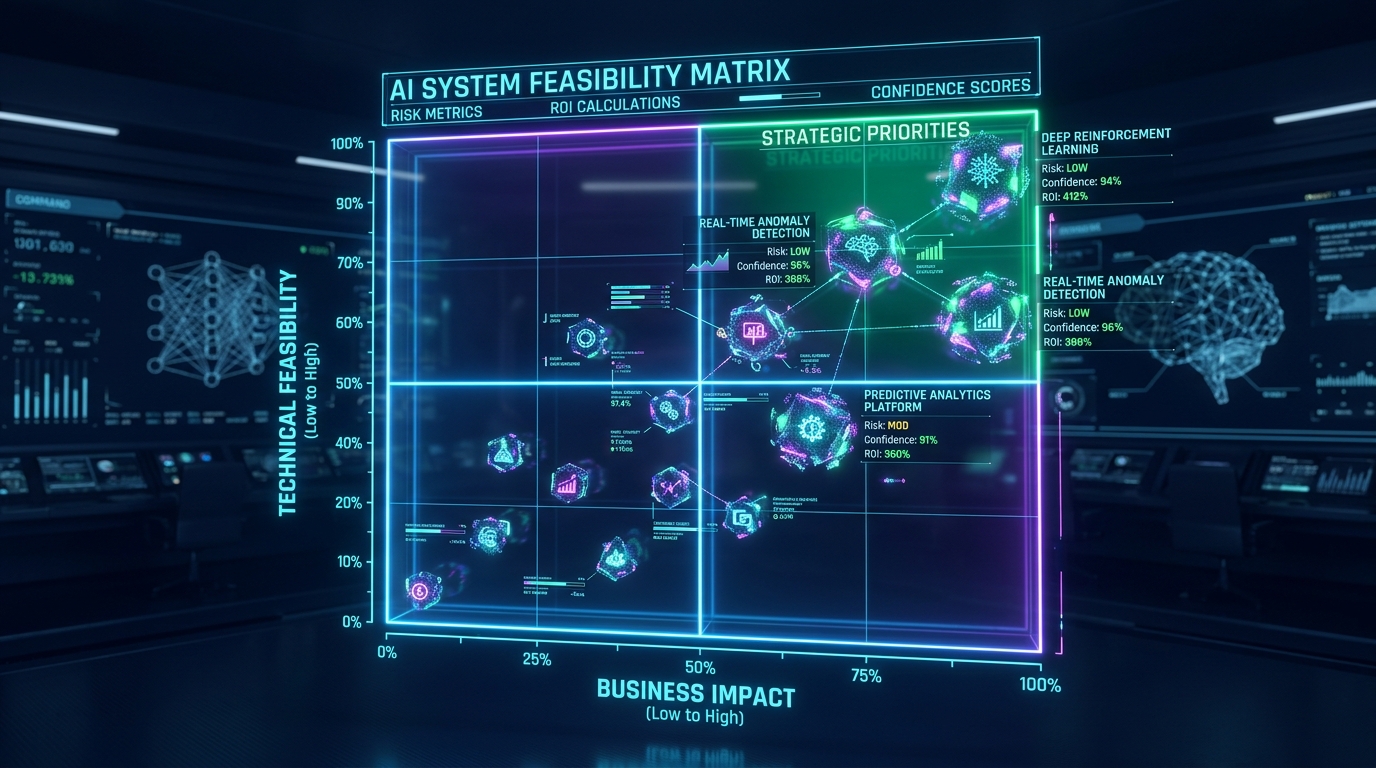
Driven by intense industry hype and board-level pressure, organizations across every sector are racing to integrate Artificial Intelligence into their business operations. Executives launch ambitious "AI transformation" initiatives, assuming that machine learning can be sprinkled across existing software systems like a magic layer.
Six months later, an alarming number of these initiatives stall:
- The custom machine learning model achieves 88% accuracy in offline testing, but the business requires 99.5% accuracy to avoid catastrophic customer support disputes.
- The training data was riddled with inconsistent human labels and silent historical biases.
- The GPU inference cost per transaction exceeds the revenue generated by the transaction itself.
- A deterministic 20-line SQL rule or regex script could have solved 90% of the problem with zero training overhead, sub-millisecond latency, and 100% explainability.
Before committing capital and engineering resources to an AI project, technical leaders must run a rigorous Engineering Feasibility & Risk Assessment.
---
1. The Four Pillars of the AI Feasibility Scorecard
Every proposed AI project should be evaluated against four foundational technical dimensions:
+-------------------------------------------------------------------------+
|                  THE AI FEASIBILITY SCORECARD                           |
+-------------------------------------------------------------------------+
                                    |
          +-------------------------+-------------------------+
          |                         |                         |
          v                         v                         v
 [ 1. TASK DETERMINISM ]   [ 2. DATA READINESS ]   [ 3. INFERENCE BUDGET ]
   Can the business          Is clean, labeled       Can unit margins
   tolerate probabilistic    ground-truth data       absorb compute and
   errors & hallucinations?  already accessible?     latency requirements?
                                    |
                                    v
                     [ 4. HUMAN-IN-THE-LOOP (HITL) ]
                       Is there an automated fallback
                       when model confidence drops?
---
2. Pillar 1: Task Determinism vs. Probabilistic Tolerance
Software systems generally fall into two paradigms:
- Deterministic Systems: Given input $X$, output $Y$ must be mathematically identical 100% of the time. (e.g., calculating sales tax, processing bank ledger debits, executing limit orders on a trading exchange).
- Probabilistic Systems: Given input $X$, the system estimates the most likely output $Y$ based on statistical patterns, with an inherent margin of error. (e.g., predicting customer churn, identifying defects on a conveyor belt, summarizing customer service notes).
The Error Tolerance Test:
Ask: "What is the business and financial consequence when the model is wrong?"
- Low Stakes / High Tolerance: Recommending related products on an e-commerce store. If the model makes a sub-optimal recommendation, the user simply ignores it. AI is an ideal fit.
- Medium Stakes / Controlled Tolerance: Extracting line items from vendor invoices into an ERP system (ERP Development). If confidence is below 95%, the document is routed to an accountant for one-click verification. AI delivers massive labor savings when paired with human review.
- High Stakes / Zero Tolerance: Calculating payroll deductions, regulatory compliance reporting, or direct financial ledger transactions. Do NOT use an AI model for these operations. Use deterministic business code with strict unit tests.
---
3. Pillar 2: Ground-Truth Data Availability and Annotation
The single most common killer of AI projects is data poverty. Companies often believe they have "tons of data" because their databases contain millions of historical records. However, raw data is not training data.
The Data Readiness Audit:
| Evaluation Criterion | Minimum Production Requirement | Common Failure Mode |
|---|---|---|
| Label Consistency | Standardized written annotation guidelines verified via multi-annotator agreement metrics (Fleiss' Kappa > 0.85). | Five different human operators labeled identical historical tickets with completely different category tags. |
| Class Balance | Sufficient positive examples of rare events (at least 200–500 distinct instances per target class). | 99.9% of historical logs are nominal; only 12 examples exist of the catastrophic failure mode you want to predict. |
| Temporal Stability | Historical data matches current operational reality (covariate shift). | Data was collected before a major supply chain, UI, or product redesign, rendering historical patterns obsolete. |
If you do not already possess clean, verified training data, your first investment must be data collection, curation, and structured annotation (AI Training Data Collection & Image Annotation), not machine learning model tuning.
---
4. Pillar 3: Inference Latency and Total Cost of Ownership (TCO)
A model that is technically brilliant in a Python notebook can be commercially unviable in production if its operating expenses destroy your gross margins.
The AI Cost Modeling Formula:
$$\text{Total AI Cost} = \text{Initial Data Prep} + \text{Model Development} + (\text{Monthly Inference API/GPU Fees}) + (\text{Drift Monitoring \& Retraining})$$
# Calculating Annual GPU Inference Cost for a Computer Vision Line
def estimate_annual_inference_cost(
    daily_items_inspected: int,
    gpu_cost_per_hour: float,
    active_operating_hours_per_day: int
) -> float:
    annual_operating_days = 260
    daily_gpu_cost = active_operating_hours_per_day * gpu_cost_per_hour
    annual_gpu_cost = daily_gpu_cost * annual_operating_days

    cost_per_inspected_item = annual_gpu_cost / (daily_items_inspected * annual_operating_days)
    print(f"Annual GPU Cost: ${annual_gpu_cost:,.2f}")
    print(f"Inference Cost per Inspected Item: ${cost_per_inspected_item:.4f}")
    return annual_gpu_cost

# Example: 1x NVIDIA L4 Edge GPU ($0.70/hr) running two 8-hr shifts (16 hrs/day)
estimate_annual_inference_cost(50000, 0.70, 16)
# Output: Annual GPU Cost: $2,912.00 | Cost per item: $0.0002
Compare this inference cost directly to the human labor savings or scrap reduction value generated by the system.
---
5. The "When NOT to Use AI" Filter
Before writing a single line of PyTorch or calling an LLM API, verify whether simpler engineering techniques solve the problem:
- Can it be solved with a database index and SQL query? Finding high-churn-risk customers can often be achieved by querying users who haven't logged in for 30 days and have 3 open support tickets. You do not need a deep neural network for basic behavioral heuristics.
- Can it be solved with regular expressions (Regex)? Extracting standardized tax IDs, phone numbers, email addresses, and invoice numbers from structured text should be handled via deterministic regex parsing before falling back to costly LLMs.
- Can it be solved with a decision table? Business logic governed by explicit policy (e.g., credit tier eligibility, discounts, routing rules) belongs in code that can be audited by compliance officers, not inside the opaque latent space of an ML model.
---
6. The 3-Week Scoping Sprint: Validate Before You Build
Never sign a six-month development contract for an unproven AI concept. Execute a structured 3-Week Scoping Sprint:
Week 1: Data Audit & Baseline Heuristic
  ├── Audit 1,000 raw production samples for label consistency.
  ├── Establish a deterministic baseline (e.g., simple keyword search or linear regression).
  └── Define the minimum threshold metric required to generate positive business ROI.

Week 2: Rapid Prototype & Error Analysis
  ├── Train an off-the-shelf model or test zero-shot foundation model performance.
  ├── Run evaluation against a clean golden validation set.
  └── Conduct deep error analysis: Categorize why the model failed on false positives.

Week 3: Financial & Operational Feasibility Report
  ├── Calculate exact latency and inference costs per transaction.
  ├── Design the human-in-the-loop fallback workflow.
  └── Present a Go / No-Go decision matrix based on verified data, not hype.
---
7. How The Serviceverse Delivers Practical AI Solutions
The Serviceverse helps organizations cut through the noise and engineer machine learning systems that deliver measurable operational returns:
- AI Feasibility & Scoping Sprints: We evaluate your data readiness, task constraints, and ROI model before you commit development capital (AI Development Services).
- Custom Machine Learning & Computer Vision: We build, benchmark, and deploy models engineered for real-world edge and cloud environments (Computer Vision Development & Machine Learning Engineering).
- End-to-End Data Pipelines: Because we manage data collection, multi-stage annotation, and quality assurance in-house, we eliminate the training data bottleneck that stalls most AI initiatives (AI Data Services).
Have an AI use case you want to validate? Contact our technical leads at info@theserviceverse.com or connect on WhatsApp at +91 7091021058 for an engineering-first feasibility evaluation.
Planning a Software, AI, or Data Initiative?
The Serviceverse helps engineering and product teams design scalable software architectures, train production computer vision models, and automate mission-critical operations.
Related Capabilities