Evaluating Mobile App Engineering Partners: 12 Technical Questions to Ask Before Signing
A rigorous technical vetting guide for founders and product leaders selecting a mobile app development partner: code ownership, offline SQLite sync, CI/CD, and App Store review.
The Serviceverse Engineering Team
Mobile Systems & Product Engineering
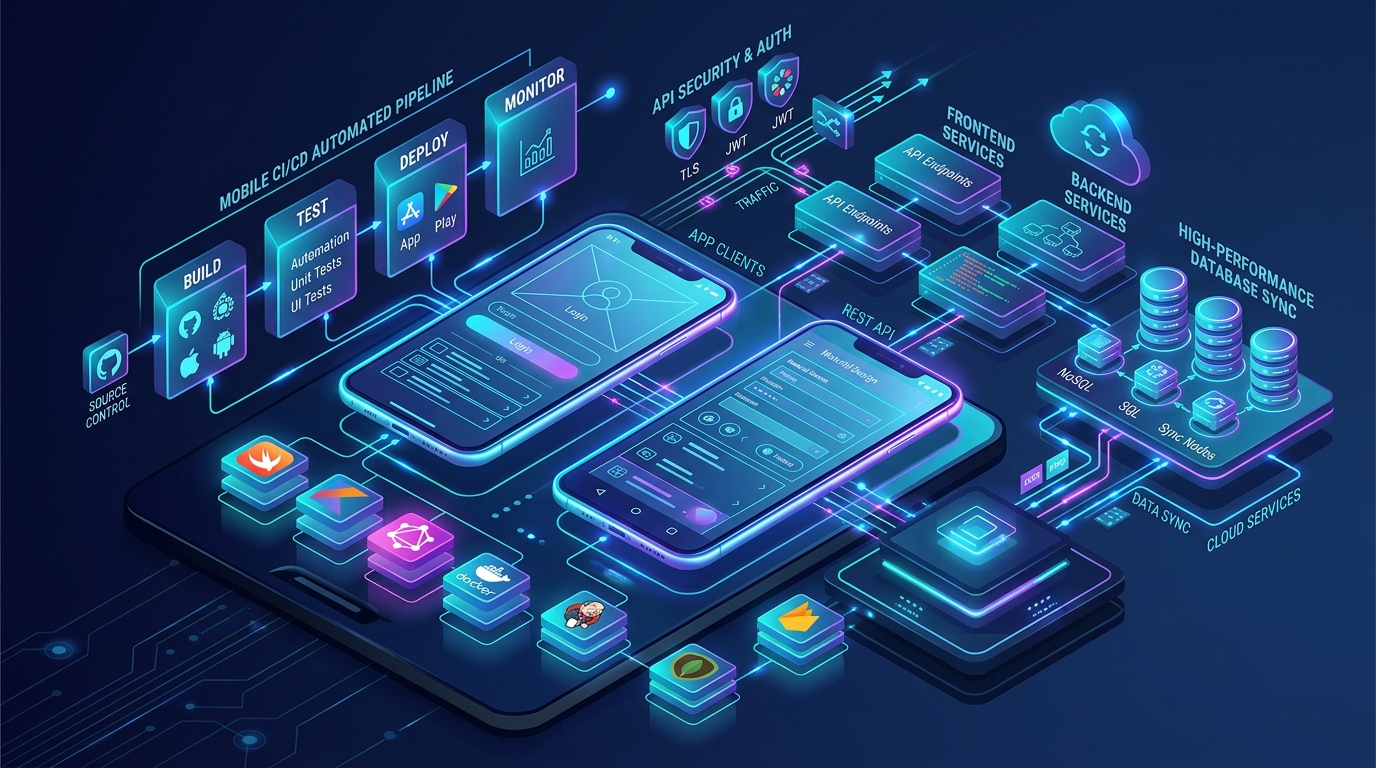
Hiring an external software engineering agency to build your mobile application is fraught with risk. In initial pitch meetings, virtually every agency presents glossy portfolio mockups, impressive client logos, and confident assurances that your iOS and Android apps can be built rapidly on budget.
Six months later, non-technical founders and product leaders frequently find themselves trapped in an engineering nightmare:
- The app crashes under intermittent 4G network conditions because offline state caching was never architected.
- Code ownership is held hostage behind disputed monthly invoices.
- Apple's App Store Review rejects the binary due to privacy guideline violations or broken in-app purchases.
- The agency utilized obscure, deprecated third-party libraries that prevent future feature upgrades without a total rewrite.
Evaluating an engineering partner requires looking past aesthetic slide decks and interrogating architectural standards, code governance, and operational resilience.
Here are the 12 non-negotiable technical questions every business leader must ask before signing a mobile development contract.
---
1. Governance, Code Ownership & CI/CD
Question 1: "Will our team have administrative ownership of the GitHub/GitLab repository from Day 1?"
The Red Flag: The agency hosts the code in their private, internal repository and promises to "transfer the code upon final project sign-off."
The Standard: Repositories must be created inside your organization’s GitHub or GitLab account from sprint zero. Every commit, pull request, code review, and automated test run must be visible to your team in real time. You should never be locked out of your own intellectual property.
Question 2: "Can you demonstrate an automated CI/CD pipeline building test binaries on every pull request?"
The Red Flag: The agency manually compiles APKs or IPAs on an individual developer's laptop and emails download links via Google Drive.
The Standard: A professional mobile engineering partner implements automated continuous integration (e.g., GitHub Actions, Fastlane, Bitrise) that automatically lints code, runs unit tests, and compiles preview builds into Apple TestFlight and Google Play Internal Testing on every merge.
---
2. Architecture & Offline Resilience
Question 3: "What cross-platform framework do you recommend for our use case, and what are its trade-offs?"
The Red Flag: The agency dogmatically recommends a single framework (e.g., "We build everything in Flutter" or "Native Swift is the only professional option") without asking about your performance requirements or existing web team skills.
The Standard:
- React Native: Excellent when you have an existing React web codebase, need shared business logic/types (TypeScript), and require high code reuse across mobile and web.
- Flutter: Strong for custom, canvas-heavy 2D graphics and highly branded UI widgets, but uses Dart (which your internal team may not know) and has larger baseline binary sizes.
- Pure Native (Swift/Kotlin): Mandatory when building deep hardware integrations (Bluetooth LE, ARKit, low-latency audio processing, or high-framerate camera algorithms).
Question 4: "How does your architecture handle poor network connectivity and offline data sync?"
The Red Flag: The agency assumes continuous high-speed Wi-Fi and simply displays a blocking spinner or generic "Network Error: Check Connection" modal whenever an API request fails.
The Standard: Professional mobile apps are built offline-first. Local databases (SQLite, WatermelonDB, Realm) act as the single source of truth for the UI. When the device loses connection, user interactions (e.g., creating a note, logging an inspection, submitting a form) are saved locally in an indexed sync queue and reconciled with the backend via idempotent APIs once connectivity returns.
+-------------------------------------------------------------------------+
|                  OFFLINE-FIRST MOBILE ARCHITECTURE                      |
+-------------------------------------------------------------------------+
  [ User Interface (UI Views) ]
               ^
               | (Reactive Observable State)
               v
  [ Local Persistent Database (SQLite / WatermelonDB) ]  <-- Immediate Write
               ^
               | (Background Sync Queue)
               v
  [ Sync Engine & Conflict Resolver ]
               |
               v (Network Check: Online?)
  +------------+------------+
  | YES                     | NO
  v                         v
[ Outbound HTTPS ]       [ Hold in Persistent Sync Queue ]
[ REST/GraphQL API ]     [ Retry with Exponential Backoff ]
---
3. Security, Authentication & Data Privacy
Question 5: "Where and how do you store sensitive user tokens and encryption keys on the device?"
The Red Flag: Storing JWT tokens or API keys in standard unencrypted storage (AsyncStorage in React Native or standard SharedPreferences in Android).
The Standard: Sensitive authentication tokens, refresh tokens, and encryption keys must be stored strictly within hardware-backed secure storage: iOS Keychain and Android Keystore / EncryptedSharedPreferences.
Question 6: "How do you manage third-party analytics SDKs and App Tracking Transparency (ATT)?"
The Red Flag: Bundling half a dozen advertising and analytics SDKs without knowing what device telemetry they collect, risking App Store rejection under Apple’s strict Privacy Manifest and ATT guidelines.
The Standard: The agency maintains a documented inventory of every third-party dependency, configures Apple Privacy Manifests (PrivacyInfo.xcprivacy), and gates optional tracking behind explicit user consent dialogs.
---
4. Testing, Delivery & Store Approvals
Question 7: "What is your automated test coverage strategy for core user flows?"
The Red Flag: "Our QA team tests the app manually on a couple of test phones before release."
The Standard: Manual testing alone guarantees regression bugs. The partner must provide automated unit tests for business logic (Jest) and automated End-to-End (E2E) integration tests (Maestro, Detox, or Appium) covering critical revenue paths: login, checkout, data submission, and offline recovery.
Question 8: "What happens if Apple or Google rejects our app submission during review?"
The Red Flag: The contract states that the agency's responsibility ends once the build is delivered, leaving store rejection resolution to your internal team.
The Standard: The contract must explicitly include store submission support and guarantee that the agency will resolve any architectural or guideline rejection issues without additional fees until public store approval is granted.
---
5. Maintenance, Upgrades & Vendor Lock-In
Question 9: "How do you structure code to avoid vendor lock-in if we bring development in-house?"
The Red Flag: The codebase is built on top of the agency’s proprietary, closed-source "starter kit" or backend BaaS, making it impossible for another engineering team to maintain the app without ongoing licensing fees.
The Standard: The codebase uses standard, open-source industry libraries and follows clean architectural patterns (feature-sliced design, modular layers, clear TypeScript interfaces). A complete developer onboarding guide and architecture diagram are delivered as contractual deliverables.
Question 10: "How will the app handle annual iOS and Android OS breaking changes?"
The Red Flag: No discussion of OS lifecycle; the agency assumes an app built today will run identically in three years.
The Standard: Apple and Google release major OS updates annually that deprecate APIs, enforce new target SDK versions, and introduce breaking permission models. A mature partner offers proactive maintenance arrangements covering annual dependency upgrades, target SDK updates, and device compatibility testing.
---
6. The Vetting Scorecard
Before committing to a vendor, score each candidate across these four categories:
| Evaluation Category | Weight | Key Verification Proof |
|---|---|---|
| Engineering Discipline | 30% | Live demonstration of GitHub CI/CD, Fastlane scripts, automated test suites. |
| Architectural Rigor | 25% | Documented offline sync strategy, secure storage implementation, minimal external SDK bloat. |
| Code Ownership & Transparency | 25% | Direct repository access from sprint 1, clear IP assignment clauses, no proprietary lock-in. |
| Store & OS Maintenance | 20% | Store rejection resolution commitment, annual OS upgrade support, SLA response terms. |
---
7. How The Serviceverse Engineers Mobile Applications
The Serviceverse builds mobile applications designed for real-world devices, intermittent networks, and long-term maintainability:
- Cross-Platform Engineering: We build robust iOS and Android apps using React Native and native modules where hardware requires it (Mobile App Development Services).
- Offline-First Data Architecture: We design local SQLite synchronization engines that keep field teams and consumers productive without network latency (Custom Software Development).
- Transparent Delivery: Every client receives full repository ownership, automated TestFlight pipelines, and complete technical handover documentation from day one (Full-Stack Engineering).
Evaluating proposals for an upcoming mobile product? Contact our mobile engineering leads at info@theserviceverse.com or connect on WhatsApp at +91 7091021058 for an honest architectural review.
Planning a Software, AI, or Data Initiative?
The Serviceverse helps engineering and product teams design scalable software architectures, train production computer vision models, and automate mission-critical operations.
Related Capabilities