Incremental Legacy Software Modernisation: The Strangler Pattern and Core Refactoring Guide
Why big-bang software rewrites fail 70% of the time, and how to safely modernize monolithic legacy applications using the Strangler Fig pattern, CDC, and characterization tests.
The Serviceverse Engineering Team
Software Architecture & Modernisation
Every established business eventually faces the legacy software dilemma. The core application that powered the company’s initial success—often a ten-year-old monolithic codebase written in PHP, Java, or .NET—has become slow to change, difficult to test, and terrifying to deploy. New developers spend weeks understanding undocumented dependencies, and each minor bug fix risks breaking adjacent business logic.
At this point, engineering leaders are tempted to propose the "Big-Bang Rewrite":
In software engineering reality, big-bang rewrites are catastrophic gambles. Industry studies indicate that over 70% of complete re-architecture projects fail to deliver on time, exceed their budgets, or are abandoned entirely. While the rewrite is underway, the business cannot respond to customer demands, and the legacy system continues to evolve in production, creating an ever-moving target.
There is a superior, battle-tested engineering path: Incremental Modernisation via the Strangler Fig Pattern.
---
1. The Strangler Fig Pattern: Conceptual Architecture
Coined by Martin Fowler, the Strangler Fig pattern takes its name from Australian fig trees whose seeds germinate in the upper branches of host trees, gradually growing roots downward until the new tree completely envelops and replaces the host.
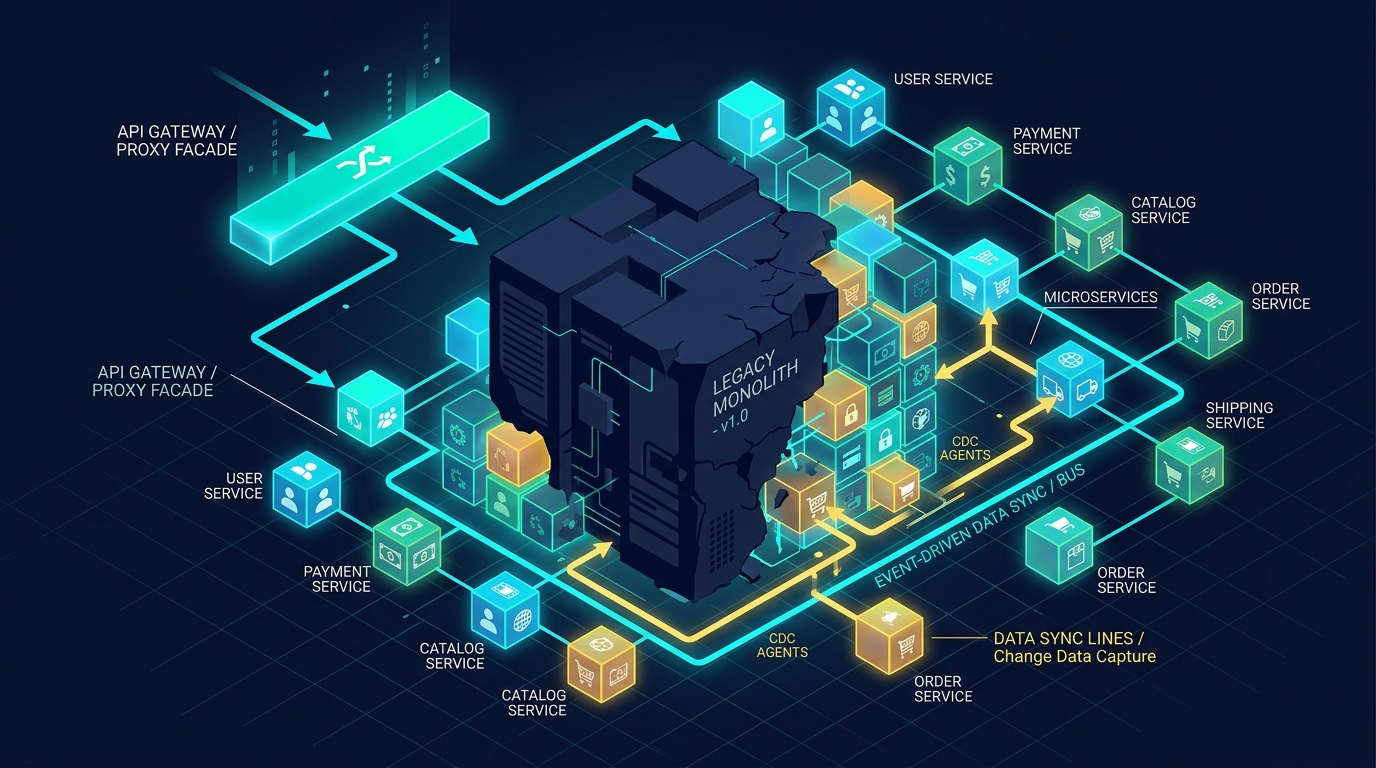
In software architecture, rather than replacing the monolith in one disruptive event, you place a routing facade (reverse proxy or API gateway) in front of the application. You then extract and build high-value domain capabilities as modern, independent services, incrementally redirecting traffic away from the legacy core until the monolith can be safely decommissioned.
PHASE 1: Interception Facade Installed
[ Clients / Mobile / Web ]
             |
             v
   [ Routing Facade (Envoy / Cloudflare / Nginx) ]
             |
             +---------> [ Monolithic Legacy Application ] (100% Traffic)
                         [ Monolithic Relational Database ]

-------------------------------------------------------------------------

PHASE 2: First High-Value Microservice Extracted
[ Clients / Mobile / Web ]
             |
             v
   [ Routing Facade ]
             |
             +---------> [ Modern Auth & Customer Service ] (Extracted)
             |                 |
             |                 v [ New PostgreSQL DB ]
             |                 | (Change Data Capture Sync)
             |                 v
             +---------> [ Legacy Core (Order / Billing / Inventory) ]
                         [ Legacy Relational Database ]

-------------------------------------------------------------------------

PHASE 3: Full Modernisation (Monolith Decommissioned)
[ Clients / Mobile / Web ]
             |
             v
   [ API Gateway & Service Mesh ]
             |
             +---------> [ Customer Service ]
             +---------> [ Billing & Invoicing Service ]
             +---------> [ Inventory & Orders Service ]
---
2. Step-by-Step Modernisation Implementation
Executing a strangler migration without interrupting ongoing business operations requires four disciplined engineering stages:
Step 1: Deploy the Interception Facade
Place an edge proxy (such as Cloudflare, AWS API Gateway, or NGINX) in front of the legacy application. Initially, 100% of routes pass through transparently to the legacy server. This step introduces zero behavioral change, but gives your engineering team the control plane needed to split traffic route by route in subsequent sprints.
Step 2: Establish Characterization Tests (The Safety Net)
Legacy codebases rarely possess comprehensive unit test suites. Before touching any code, write characterization tests (black-box regression tests).
- Capture live HTTP production requests and responses (with sensitive PII redacted).
- Replay these requests against the legacy system to establish an exact baseline of current behavior—including undocumented quirk behaviors and edge-case error responses that downstream integrations depend on.
Step 3: Extract a Non-Critical, High-Value Vertical Slice
Do not start by extracting the most complex, tangled core of your system (such as billing or inventory reservation). Start with an edge domain that is relatively self-contained:
- User Authentication & Session Management.
- Notification & Email Dispatch Services.
- Read-Heavy Reporting Dashboards.
Build this slice as a modern service using clean architecture principles, modern frameworks (such as Next.js and Node/Go/Python backends), and an independent database.
Step 4: Handle Data Synchronization via Change Data Capture (CDC)
The hardest challenge in legacy modernisation is data consistency. If both the new microservice and the legacy monolith need customer records, avoid brittle two-phase commits (2PC).
Instead, utilize Change Data Capture (CDC) via tools like Debezium and Apache Kafka:
- The new service writes to its modern database.
- Debezium reads the database transaction log directly and publishes change events to Kafka.
- A synchronization worker updates the legacy database in near real-time, ensuring backward compatibility for parts of the monolith that still rely on the old schema.
-- Example: Reverse Proxy Routing Logic (Nginx Facade)
server {
    listen 443 ssl;
    server_name api.theserviceverse.com;

    # 1. Newly Modernized Customer Domain -> Route to Microservice
    location /v1/customers {
        proxy_pass http://customer-service-cluster.internal;
        proxy_set_header Host $host;
        proxy_set_header X-Forwarded-For $remote_addr;
    }

    # 2. Newly Modernized Authentication -> Route to Auth Service
    location /v1/auth {
        proxy_pass http://auth-service-cluster.internal;
        proxy_set_header Host $host;
    }

    # 3. Default Fallback -> Pass through to Legacy Monolith
    location / {
        proxy_pass http://legacy-monolith.internal;
        proxy_set_header Host $host;
        proxy_set_header X-Forwarded-For $remote_addr;
    }
}
---
3. When In-Place Refactoring Is Smarter Than Microservices
Microservices introduce distributed system complexity: network latency, eventual consistency, distributed tracing, and complex Kubernetes operations.
Before extracting every module into a separate repository, consider In-Place Monolith Modernisation:
- Modular Monolith Architecture: Restructure the existing codebase into strictly encapsulated domain modules within the same project. Enforce boundary rules (e.g., Module A cannot query Module B's database tables directly; it must call Module B's public interface).
- Framework & Runtime Upgrades: Upgrading a legacy system from PHP 5.6 to PHP 8.3, or from .NET Framework 4.5 to .NET 8, often delivers 3x throughput improvements and modern language ergonomics without any microservices overhead.
- Database Indexing & Read Replicas: 80% of perceived "legacy software slowdowns" are caused by missing database indexes, un-cached queries, and un-paginated list endpoints. Resolving database bottlenecks in-place can extend the lifespan of an existing platform by years at a fraction of rewrite costs.
---
4. Key Lessons for Engineering Leaders
- Never Freeze Feature Development: A modernisation project that halts business delivery will quickly lose executive support. Deliver product features alongside modernisation sprints.
- Decommission Aggressively: The most dangerous phase of a strangler migration is running both old and new systems indefinitely. Set firm deadlines to cut off legacy paths once parity is proven.
- Focus on Business Value, Not Framework Fashion: Modernisation should be justified by tangible operational outcomes—faster page loads, higher deployment frequency, reduced cloud hosting bills—not merely because a framework is trendy.
---
5. How The Serviceverse Modernizes Legacy Systems
At The Serviceverse, we specialize in pragmatic, low-risk software engineering for mission-critical enterprise systems:
- Legacy Refactoring & Re-Architecture: We safely decouple legacy monoliths into scalable, maintainable architectures without downtime (Custom Software Development).
- Modern Web & API Modernisation: We rebuild legacy web portals into fast, responsive Next.js applications backed by clean REST and GraphQL APIs (Web Development Services).
- Backend & Integration Services: We build resilient message queues, CDC pipelines, and database synchronizers to ensure data integrity throughout your modernisation journey (API & Backend Development).
Struggling with a legacy monolith or planning an incremental modernisation? Talk to our senior software architects at info@theserviceverse.com or reach out via WhatsApp at +91 7091021058.
Planning a Software, AI, or Data Initiative?
The Serviceverse helps engineering and product teams design scalable software architectures, train production computer vision models, and automate mission-critical operations.
Related Capabilities