From Sensor Telemetry to Maintenance Alerts: Designing an Industrial IoT & AI Pipeline
How to architect a reliable predictive maintenance pipeline: connecting edge sensor protocols (OPC-UA, MQTT), time-series feature extraction, and automated work orders.
The Serviceverse Engineering Team
IoT & Distributed Systems
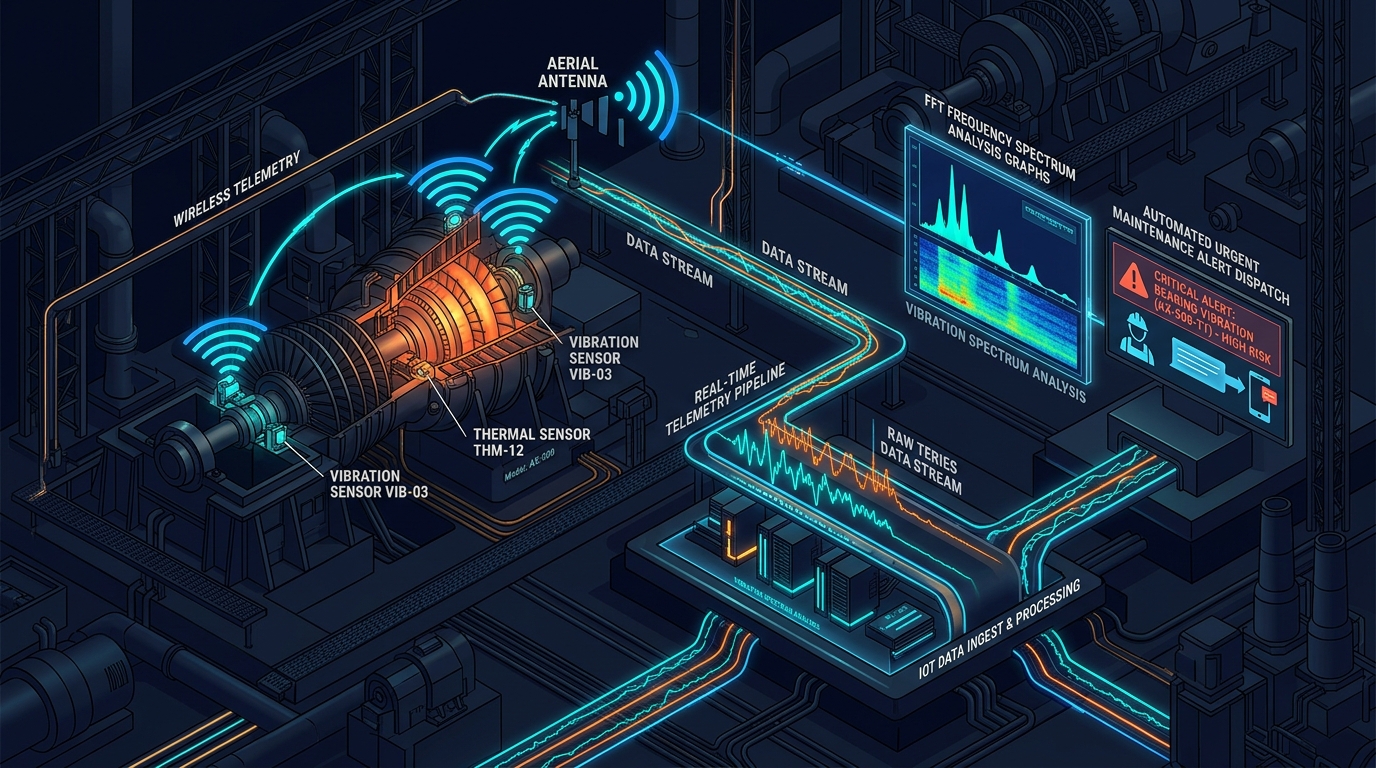
Unplanned industrial downtime costs manufacturing plants millions of dollars annually in lost throughput, scrap materials, and emergency overtime. To combat this, factories have installed thousands of vibration, temperature, current, and acoustic sensors across heavy machinery.
However, many plants encounter a frustrating paradox: despite generating gigabytes of telemetry data every day, their maintenance teams remain entirely reactive. Sensors sit in siloed historian databases, or worse, they trigger hundreds of daily nuisance threshold alerts that operators learn to ignore.
Moving from raw sensor telemetry to high-confidence, actionable maintenance dispatch requires an engineered data pipeline. This article details the end-to-end architecture for building an industrial AI and IoT workflow.
---
1. Why Static Threshold Alarms Cripple Maintenance Teams
Traditional supervisory control and data acquisition (SCADA) systems rely on static upper and lower control limits:
While simple to configure, static thresholds fail in dynamic industrial operating environments:
- Late Warning Horizon: By the time a heavy roller bearing reaches 85°C, mechanical spalling or cage disintegration has already occurred. The component cannot be scheduled for maintenance during the next shift change; the line must be halted immediately.
- False Positives from Variable Loads: When an extruder motor runs at 100% capacity during a peak production run, its normal operating vibration amplitude will exceed thresholds calibrated during a 60% load cycle, triggering false alarms.
- Compound Degradation Signatures: Catastrophic failure modes often manifest not as a single extreme value, but as a subtle harmonic shift across multiple sensor modalities (e.g., a 2% rise in high-frequency acoustic emission accompanied by a 0.5A increase in motor phase current).
+--------------------------------------------------------------------------+
|                        INDUSTRIAL ASSETS (Pumps, Motors)                 |
|       [ Accelerometer ]     [ Thermocouple ]     [ Current Clamp ]       |
+--------------------------------------------------------------------------+
                                     | (Analog 4-20mA / IO-Link)
                                     v
+--------------------------------------------------------------------------+
|                     EDGE GATEWAY & PROTOCOL CONVERSION                   |
|     - Modbus / OPC-UA / Profinet Ingestion                               |
|     - Local FFT Preprocessing & High-Frequency Decimation                |
|     - Edge MQTT Broker (Sparkplug B / TLS 1.3)                           |
+--------------------------------------------------------------------------+
                                     | (Secure MQTT over WAN)
                                     v
+--------------------------------------------------------------------------+
|                  TIME-SERIES INGESTION & FEATURE STORE                   |
|     - Distributed Message Queue (Apache Kafka / AWS Kinesis)             |
|     - Time-Series Database (InfluxDB / TimescaleDB)                      |
|     - Feature Extraction (RMS, Kurtosis, Crest Factor, Peak Frequencies) |
+--------------------------------------------------------------------------+
                                     |
                                     v
+--------------------------------------------------------------------------+
|                    MACHINE LEARNING & ANOMALY INFERENCE                  |
|     - Unsupervised Isolation Forest / Autoencoder Reconstruction         |
|     - Remaining Useful Life (RUL) Weibull Survival Analysis              |
+--------------------------------------------------------------------------+
                                     |
                                     v
+--------------------------------------------------------------------------+
|               ERP / CMMS INTEGRATION & DISPATCH WORKFLOW                 |
|     - Automated Preventative Work Order Creation in ERP                  |
|     - SMS / WhatsApp Shift Alert with Root-Cause Diagnostics             |
+--------------------------------------------------------------------------+
---
2. Ingestion Architecture: Industrial Protocols to Edge Gateways
Industrial machines communicate over specialized fieldbus protocols designed for deterministic real-time control, not REST APIs.
The Protocol Stack
- OPC Unified Architecture (OPC-UA): The modern standard for cross-vendor industrial interoperability. OPC-UA provides rich object information models and cryptographic message signing.
- Modbus TCP / RTU: A legacy master-slave protocol still ubiquitous on pumps, chillers, and energy meters. Modbus transmits raw 16-bit register addresses without metadata.
- MQTT with Sparkplug B: The premier standard for transmitting industrial telemetry over enterprise networks. Sparkplug B provides state management (birth/death certificates), standardized topic namespaces, and lightweight Google Protocol Buffer compression.
Edge Gateway Ingestion
Rather than streaming raw 20 kHz vibration waveforms directly to the cloud—which would saturate factory network bandwidth and generate astronomical cloud ingress costs—an industrial edge gateway (such as a Siemens IOT2050 or Advantech IPC running Linux) performs local decimation and transformation:
# Edge Preprocessing: Extracting statistical time-domain features locally
import numpy as np
from scipy.stats import kurtosis, skew

def compute_vibration_features(raw_waveform: np.ndarray, sample_rate: int) -> dict:
    """
    Transforms 20,000 raw acceleration samples into lightweight analytical features.
    """
    rms = np.sqrt(np.mean(raw_waveform ** 2))
    peak = np.max(np.abs(raw_waveform))
    crest_factor = peak / (rms + 1e-9)
    kurt = kurtosis(raw_waveform)

    # Fast Fourier Transform for dominant frequency identification
    fft_vals = np.abs(np.fft.rfft(raw_waveform))
    fft_freqs = np.fft.rfftfreq(len(raw_waveform), 1.0 / sample_rate)
    dominant_frequency_hz = fft_freqs[np.argmax(fft_vals[1:]) + 1]

    return {
        "rms_velocity": round(float(rms), 4),
        "peak_acceleration": round(float(peak), 4),
        "crest_factor": round(float(crest_factor), 2),
        "kurtosis": round(float(kurt), 2),
        "dominant_freq_hz": round(float(dominant_frequency_hz), 1)
    }
---
3. Machine Learning Models: Anomaly Detection vs. Remaining Useful Life
Predictive maintenance machine learning generally falls into two distinct operational stages:
| Approach | Machine Learning Model | Data Requirement | Output | Best Suited For |
|---|---|---|---|---|
| Unsupervised Anomaly Detection | Isolation Forests, Deep Autoencoders, One-Class SVM | Only nominal (healthy) baseline data | Anomaly score (0.0 to 1.0) | Early warning of unknown mechanical failure modes |
| Remaining Useful Life (RUL) | LSTM Recurrent Networks, Weibull Survival Models | Run-to-failure historical datasets | Estimated operating hours before failure | Critical rotating assets with documented failure histories |
Why Autoencoders Excel in Industrial Environments
Because factories rarely possess extensive labeled datasets of catastrophic machine failures, autoencoders are highly effective. The model is trained exclusively on weeks of normal operation to compress and reconstruct nominal sensor feature vectors.
When an asset begins to develop mechanical looseness or bearing cage wear, the statistical relationships between vibration harmonics and motor load shift. The autoencoder cannot reconstruct this unfamiliar pattern cleanly. The resulting spike in reconstruction error provides a reliable early warning weeks before physical heat or visible vibration manifests.
---
4. Closing the Loop: ERP & CMMS Automated Dispatch
A predictive maintenance model is useless if the alert dies in an analytics dashboard. True business value is realized only when the system triggers physical intervention.
When an anomaly score crosses the secondary confirmation threshold:
- Deduplication & Window Filtering: The alert engine verifies the anomaly persists across at least three consecutive 5-minute sampling windows to eliminate transient electrical noise.
- ERP/CMMS API Trigger: The backend generates an automated preventative work order in the enterprise maintenance management system (ERP Development), specifying:
- Target asset ID and physical plant location.
- Identified anomaly category (e.g., “High-frequency bearing cage resonance detected on Drive End”).
- Recommended replacement parts and historical service manual link.
- Escalation Notification: An instant alert is routed to the on-duty shift supervisor via WhatsApp or SMS with one-click acknowledgment.
---
5. When Rule-Based Condition Monitoring Is Enough
Machine learning is not always required. You should stick with deterministic, rule-based condition monitoring when:
- Machines Run Under Constant Speed and Load: If an industrial ventilation fan runs at a constant 1,800 RPM 24/7, ISO 10816 vibration severity charts provide standard velocity thresholds (e.g., RMS > 4.5 mm/s) that require no AI training.
- The Asset Is Readily Replaceable: Low-cost auxiliary pumps that can be hot-swapped in 15 minutes do not justify the software development and sensor instrumentation costs of a custom ML pipeline.
- Data Ingestion Is Intermittent: Predictive ML models require consistent, high-frequency time-series telemetry. If your factory cannot maintain reliable connectivity or power to the sensor cluster, deterministic physical audits remain superior.
---
6. How The Serviceverse Helps Build Industrial Telemetry Systems
The Serviceverse engineers reliable, scalable IoT and predictive maintenance systems from edge protocols to enterprise business software:
- Custom Machine Learning Pipelines: We train and deploy edge and cloud predictive analytics pipelines customized to your equipment kinematics (Machine Learning Engineering).
- Enterprise ERP & CMMS Integration: We build and integrate custom maintenance dispatch modules, automating the flow from telemetry alert to technician resolution (Custom ERP Engineering).
- Distributed Backend Infrastructure: We design scalable message queues, time-series stores, and real-time operations dashboards (Custom Software Development).
Ready to connect your factory sensors to intelligent operational workflows? Reach out to our engineering leads at info@theserviceverse.com or contact us on WhatsApp at +91 7091021058.
Planning a Software, AI, or Data Initiative?
The Serviceverse helps engineering and product teams design scalable software architectures, train production computer vision models, and automate mission-critical operations.
Related Capabilities