
What a Real Estate Website Needs Beyond Property Listings
Why standard MLS feeds fail to convert buyers and sellers, and the four essential architectural capabilities that turn property portals into high-velocity lead engines.
Editorial Team
Web Architecture Specialist
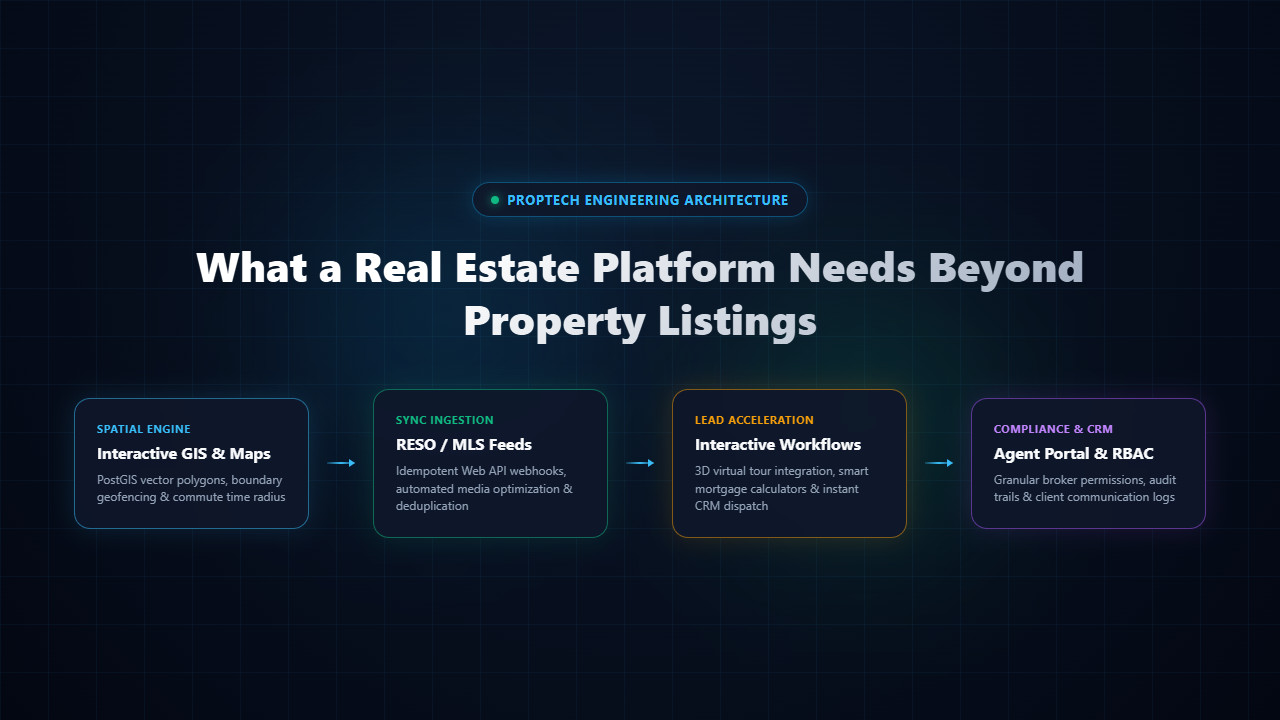
Many brokerage firms and real estate developers invest substantial capital into digital platforms, only to discover that their traffic bounce rates are high and inquiry volume remains disappointing.
The root cause is almost always the same: they built a static property catalog rather than an interactive conversion platform.
In an era where massive listing aggregators syndicate identical MLS/IDX feeds across thousands of websites, a local brokerage cannot win on listing inventory alone. Winning requires specialized user experiences, localized utility tools, and frictionless inquiry routing.
Below are the key architectural capabilities modern real estate websites need beyond basic listing grids.
1. Instant Automated Valuation & Seller Lead Funnels
While buyers browse listings casually, home sellers are your most valuable audience. Sellers rarely submit a generic "Contact Us" form to ask what their property might fetch.
A modern real estate platform incorporates an interactive property valuation calculator:
- Homeowners enter their street address, property type, square footage, and recent renovation details.
- The system benchmarks historical regional sales data and presents an estimated valuation range.
- To receive the comprehensive comparative market analysis (CMA), the user enters their contact details.
- This single workflow converts passive visitors into qualified seller leads.
2. Frictionless WhatsApp and Omnichannel Inquiry Capture
Real estate decisions are emotional, urgent, and hyper-mobile. Requiring prospective buyers to fill out seven fields on a desktop form creates unnecessary friction.
This pre-populated context saves time for the client and ensures your sales team knows exactly which listing sparked the conversation.
3. Direct Bi-Directional CRM Synchronization
When a buyer saves a favorite listing, books an open-house viewing, or submits an inquiry, that data must not be trapped in email notification threads:
- Automated lead enrichment: The user profile is instantly created or updated inside your CRM platform (see our CRM Development services).
- Behavioral tagging: Track whether a user is looking for luxury 3-bedroom penthouses or commercial office spaces based on their search history.
- Automated listing alerts: When a new property matching their saved search criteria is published, the platform automatically triggers an email or WhatsApp digest.
| Traditional Real Estate Website | High-Converting Modern Real Estate Platform |
|---|---|
| Static grid of photos and text descriptions | Interactive floor plans, virtual tours, and neighborhood data |
| Generic contact form with 8 required fields | One-click WhatsApp inquiry with pre-filled listing IDs |
| Inquiries forwarded to a generic email inbox | Direct integration with sales CRM and automated lead routing |
| Slow mobile page speeds from unoptimized images | Next.js image optimization with sub-second Core Web Vitals |
| Zero seller capture tools | Instant comparative property valuation and CMA calculators |
4. Hyper-Local Neighborhood Guides for Organic Search Authority
National portals struggle to create authentic, in-depth neighborhood content. This presents a massive search engine optimization (SEO) advantage for regional agencies.
Create structured hub pages for each neighborhood covering:
- School district ratings and proximity.
- Public transit access, commute times, and highway arterial connections.
- Local dining hubs, parks, and upcoming civic infrastructure projects.
- Average price per square foot trends over the past five years.
These informative guides capture high-intent buyers who are searching for "best family neighborhoods in [City]" months before they choose an agent.
5. Performance and Image Engineering
Property listings are visually intensive. A single luxury listing page may host 40 high-resolution interior photos. If unoptimized, the page weight exceeds 25 megabytes, triggering terrible Core Web Vitals and frustrating mobile buyers on cellular connections.
By utilizing modern frameworks like Next.js:
- Images are automatically resized and served in next-gen WebP/AVIF formats.
- Below-the-fold gallery thumbnails are lazily loaded on demand.
- Hero photos are prioritized with clean responsive viewports.
To explore custom web engineering and real estate portals, see our Web Development and Custom Software Development capabilities, or discuss your technical requirements with our engineering team at info@theserviceverse.com.
Planning a Software, AI, or Data Initiative?
The Serviceverse helps engineering and product teams design scalable software architectures, train production computer vision models, and automate mission-critical operations.
Related Capabilities