Architecting Connected Business Systems: Unifying Custom Software, CRM, and Workflow Automation
How to avoid point-to-point integration chaos as your business scales: event-driven architecture, idempotent webhook pipelines, and clean data ownership across custom software, CRM, and ERP.
The Serviceverse Engineering Team
Enterprise Systems Architecture
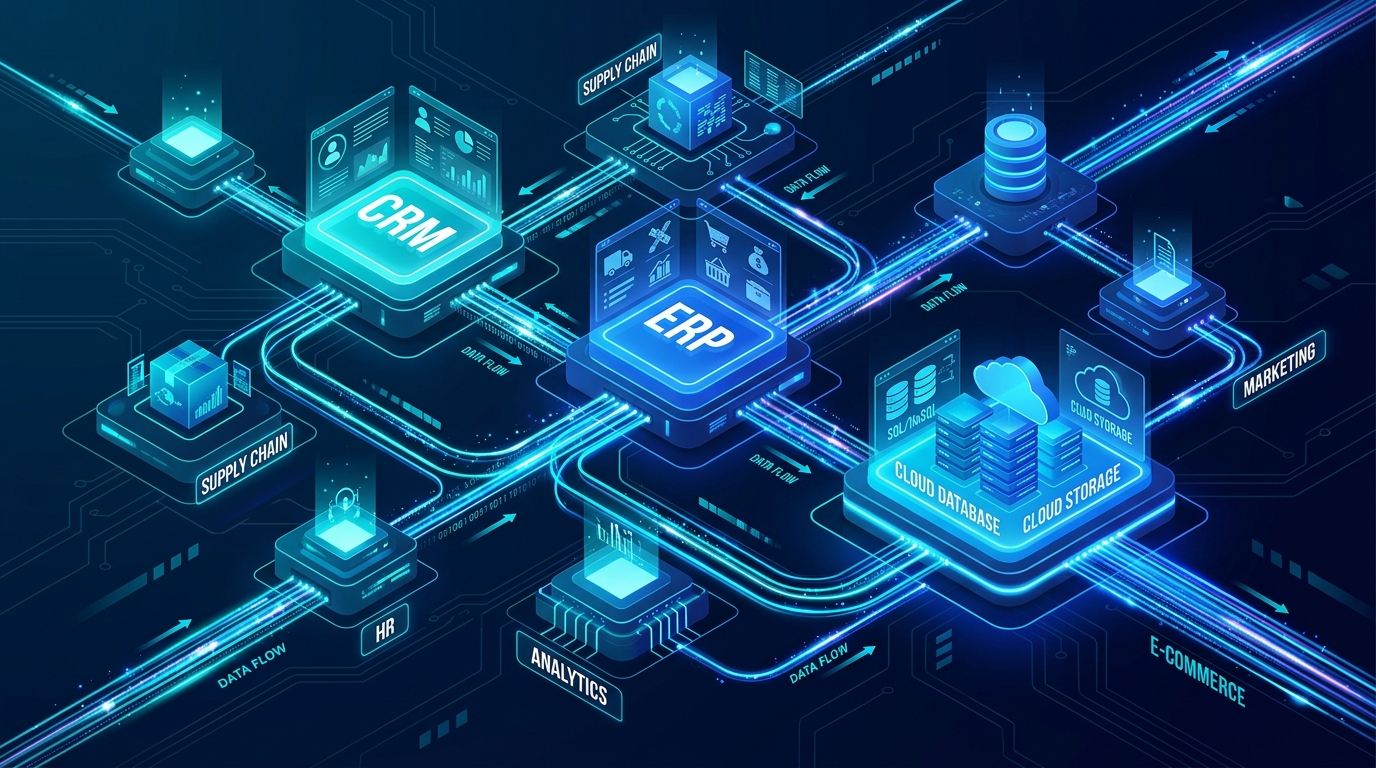
As a company grows from a dozen employees to hundreds, its software ecosystem expands rapidly. What began as a single custom web application and a shared accounting tool inevitably fragments into a constellation of specialized platforms: a customer relationship management (CRM) tool for sales, an enterprise resource planning (ERP) platform for inventory and procurement, a custom client-facing portal, and third-party billing services.
Initially, teams bridge these systems with quick fixes: scheduled hourly cron jobs, manual CSV exports, or brittle direct API integrations.
Over time, this creates point-to-point integration spaghetti. If you have five business systems connected directly to one another, you must build and maintain 10 separate bilateral interfaces; with eight systems, you are managing 28 brittle connections. When one system modifies its API schema or suffers an outage, data falls out of sync, leading to phantom inventory, duplicate customer billing, and hours of manual data reconciliation.
To scale predictably, growing businesses must transition to a Cohesive, Event-Driven Integration Architecture.
---
1. The Point-to-Point Trap vs. Event-Driven Architecture
In a naive point-to-point architecture, when a customer completes an order on your custom web portal, the web application synchronously attempts to call three external systems:
- It calls the payment gateway.
- It calls the CRM API to update deal stage.
- It calls the ERP API to reserve warehouse inventory.
If the ERP platform is undergoing maintenance and returns a 503 Service Unavailable, what happens? The entire checkout transaction crashes, or the payment is captured while the order never registers in the warehouse.
In an Event-Driven Architecture (EDA), applications communicate asynchronously via a centralized message broker (such as RabbitMQ, Apache Kafka, or AWS SQS/EventBridge):
- The web portal simply publishes a single domain event:
OrderPlaced. - The message broker durably persists the event.
- Downstream systems (CRM, ERP, Email Dispatch, Billing) consume the event independently at their own processing pace. If the ERP is temporarily offline, the message remains safely in the queue until the service recovers.
NAIVE POINT-TO-POINT SPAGHETTI (Brittle & Tightly Coupled)
[ Custom Web App ] <=======> [ CRM System ]
       ||   \               /     ||
       ||    \             /      ||
       ||     \           /       ||
       ||      v         v        ||
[ Payment Gate ] <=========> [ ERP Platform ]

-------------------------------------------------------------------------

EVENT-DRIVEN ARCHITECTURE (Decoupled & Resilient)
[ Custom Web Portal ] ---> Emits: "OrderPlaced"
                               |
                               v
               [ Distributed Event Bus / Message Broker ]
               [ (RabbitMQ / Apache Kafka / AWS EventBridge) ]
                               |
            +------------------+------------------+
            |                  |                  |
            v                  v                  v
     [ CRM Consumer ]   [ ERP Consumer ]   [ Notification Consumer ]
     (Updates Lead)     (Allocates Stock)  (Dispatches WhatsApp/Email)
---
2. Defining Single Sources of Truth (SSOT)
System integration disputes almost always originate from ambiguous data ownership. When the same customer address exists in the custom portal, the CRM, and the ERP, which system's record takes precedence when they conflict?
Establish a strict Data Ownership Hierarchy:
| Data Domain | Single Source of Truth (SSOT) | Consumer Systems | Permitted Sync Direction |
|---|---|---|---|
| Prospective Leads & Pipeline Deals | CRM Platform | Marketing, Analytics | CRM $\rightarrow$ Portal / Analytics |
| Inventory, BOM & Accounting Ledger | ERP System | Web Storefront, CRM | ERP $\rightarrow$ Web App / CRM (Read-Only) |
| End-User Identity & Auth Credentials | Custom Web App (Identity Provider) | CRM, Support Desk | Web App $\rightarrow$ CRM |
| Order Placement & Fulfillments | Order Processing Service | CRM, ERP, Logistics | Web App $\rightarrow$ ERP (via Event Bus) |
Golden Rule: No data entity should be master-edited in multiple systems simultaneously. One system owns the write authority; all other systems receive automated read-only synchronizations.
---
3. Engineering Reliable Webhook Pipelines: Idempotency & Backoff
When connecting third-party SaaS platforms to your custom software, webhooks are the primary integration mechanism. However, webhooks operate over public internet connections, meaning network timeouts, duplicate deliveries, and out-of-order events are guaranteed to occur.
A. Idempotency: Defending Against Duplicate Events
Payment processors and CRMs frequently retry webhooks if your server takes longer than 2,000 milliseconds to respond. If your handler processes the same PaymentSucceeded webhook twice, you risk charging the client twice or provisioning double credits.
Every incoming webhook event must include an Idempotency Key (e.g., the provider’s event ID). Before executing business logic, store the key in Redis or a database unique index:
// Example: Idempotent Webhook Handler in Next.js / Node.js
import { NextRequest, NextResponse } from "next/server";
import { redis } from "@/lib/redis";
import { processOrderPayment } from "@/services/order";

export async function POST(req: NextRequest) {
  const payload = await req.json();
  const eventId = payload.id; // e.g., evt_3MvY82...

  // 1. Atomically check and lock the event ID in Redis with a 24-hr TTL
  const isDuplicate = !(await redis.set(`webhook:processed:${eventId}`, "1", {
    nx: true, // Only set if not already exists
    ex: 86400, // Expire after 24 hours
  }));

  if (isDuplicate) {
    console.warn(`[webhook] Duplicate event ignored: ${eventId}`);
    return NextResponse.json({ status: "already_processed" }, { status: 200 });
  }

  try {
    // 2. Execute business logic asynchronously or via background job
    await processOrderPayment(payload.data);
    return NextResponse.json({ status: "success" }, { status: 200 });
  } catch (error) {
    // If failure occurs, remove Redis key so the provider's retry can succeed
    await redis.del(`webhook:processed:${eventId}`);
    return NextResponse.json({ error: "Internal processing error" }, { status: 500 });
  }
}
B. Exponential Backoff and Dead-Letter Queues (DLQ)
When downstream services fail, retry with jittered exponential backoff (e.g., retry after 2s, 8s, 32s, 2m, 10m). If the transaction fails five consecutive attempts, automatically route the message into a Dead-Letter Queue (DLQ) and trigger an alert. Engineers can inspect the malformed payload, fix the bug, and replay the message without data loss.
---
4. Handling Distributed Transactions: The Saga Pattern
When a business process spans multiple independent systems (e.g., Order Placed $\rightarrow$ Payment Captured $\rightarrow$ ERP Stock Deducted $\rightarrow$ Shipping Label Generated), traditional relational database transactions (BEGIN ... COMMIT) cannot cross service boundaries.
The Saga Pattern solves this using coordinated local transactions and compensating actions:
- If Step 1 (Payment) succeeds and Step 2 (Inventory) succeeds, but Step 3 (Shipping) fails:
- The orchestrator executes compensating rollback events: it triggers an automated refund for the payment in Step 1 and returns the reserved stock in Step 2.
- The customer receives a clear explanation, and the system returns to a consistent state without phantom records.
---
5. Migration Roadmap: From Spaghetti to Cohesion
Transitioning an existing business from manual spreadsheets and point-to-point scripts does not require a risky rewrite:
Month 1: Canonical Data Dictionary & Audit
  ├── Map all existing systems, database schemas, and manual CSV exports.
  └── Explicitly designate the Single Source of Truth (SSOT) for every data entity.

Month 2: Ingress Gateway & Event Broker
  ├── Deploy a centralized message queue (e.g., AWS SQS or RabbitMQ).
  ├── Standardize inbound webhook receivers with signature verification and idempotency keys.
  └── Stream core business events (New Lead, Deal Won, Order Paid) into the broker.

Month 3: Incremental Consumer Extraction
  ├── Replace fragile cron jobs with event-driven consumers one by one.
  ├── Deploy Dead-Letter Queues and replay tooling for failed messages.
  └── Establish monitoring dashboards for queue lag and sync latency.
---
6. How The Serviceverse Architects Connected Business Systems
At The Serviceverse, we eliminate operational silos by engineering reliable, interconnected software ecosystems:
- Custom Software & Web Portals: We build custom web applications and client portals designed to communicate cleanly with your enterprise tools (Custom Software Engineering).
- Tailored CRM Platforms: We build and configure customer management platforms shaped around your actual sales pipeline, with AI-assisted workflows and two-way ERP syncing (CRM Development).
- Enterprise ERP Engineering: We design modular ERP systems covering finance, inventory, and procurement that integrate seamlessly with your existing software (ERP Development).
Ready to eliminate manual data entry and unify your business software? Contact our integration architects at info@theserviceverse.com or reach out via WhatsApp at +91 7091021058.
Planning a Software, AI, or Data Initiative?
The Serviceverse helps engineering and product teams design scalable software architectures, train production computer vision models, and automate mission-critical operations.
Related Capabilities
Related Articles
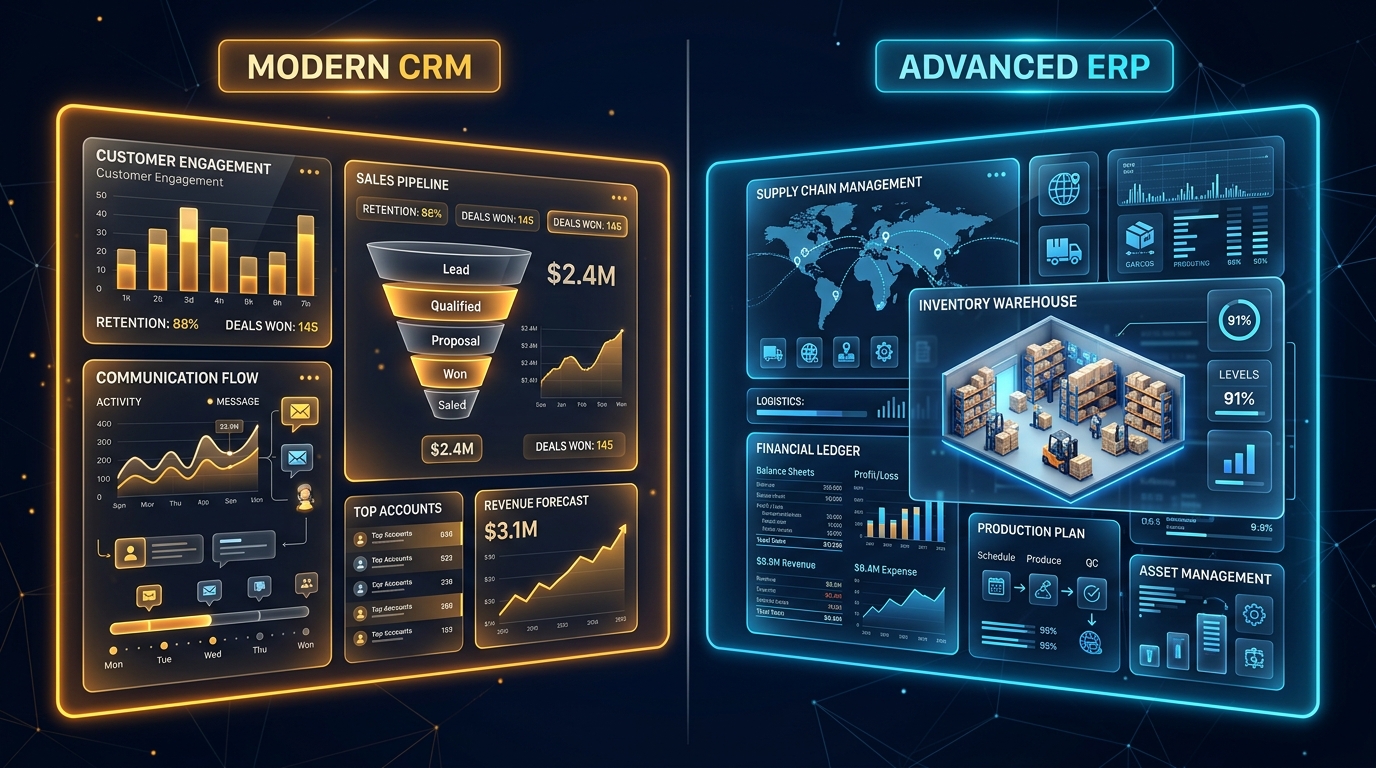
CRM vs ERP: What Does Your Business Need?
Understand the core distinctions between CRM and ERP platforms, how data flows between front and back-office operations, and how to decide what to implement first.
Enterprise Systems Specialist