
Image Annotation and Segmentation: Key Differences
A deep dive into bounding boxes, polygon masks, semantic segmentation, and instance segmentation: costs, labeler speed, and model training tradeoffs.
Editorial Team
Computer Vision Annotation Lead
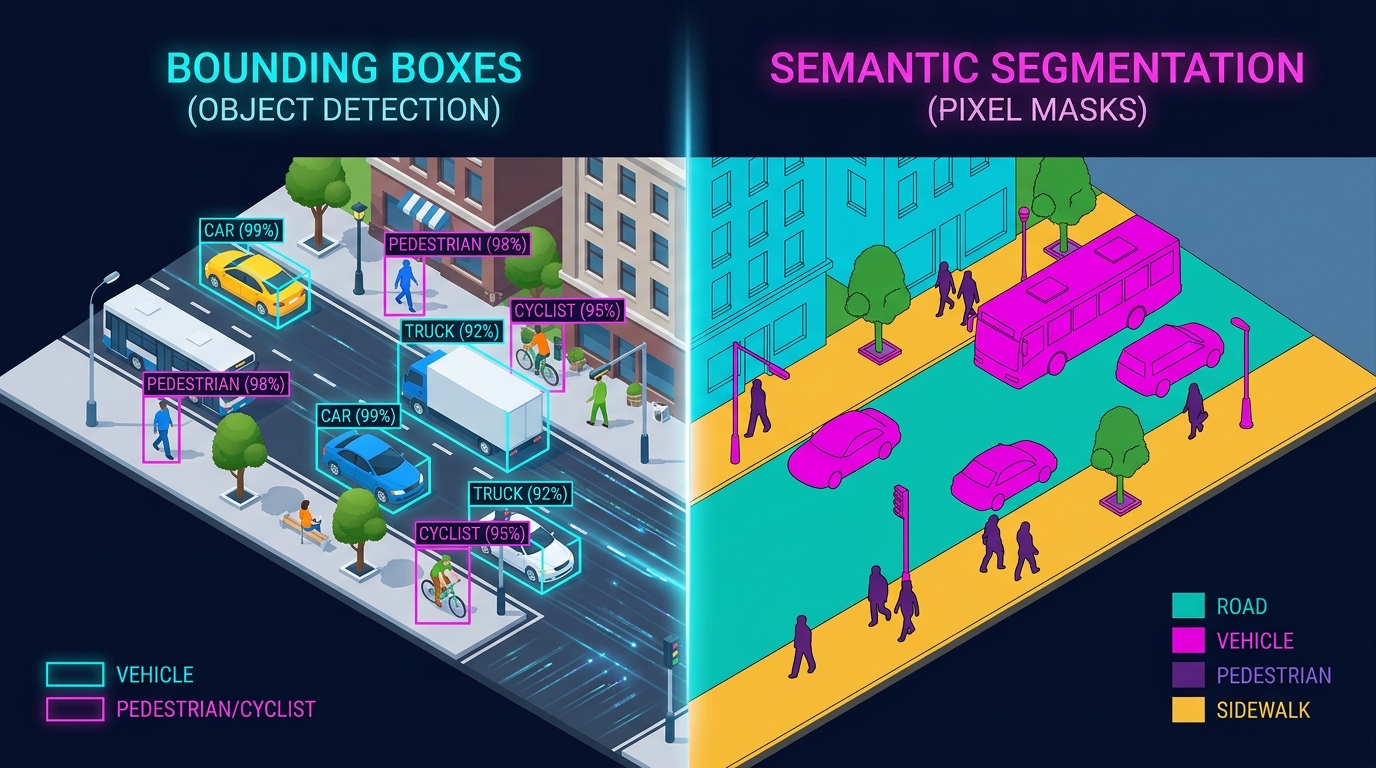
Supervised computer vision models depend entirely on ground-truth training data. However, machine learning teams frequently struggle to determine the appropriate granularity of visual labeling:
Should you draw simple rectangular bounding boxes, tight polygons, or full pixel-level segmentation masks?
Choosing an annotation format that is too coarse can prevent your model from learning complex spatial boundaries, while choosing an overly complex technique can multiply data labeling costs by a factor of ten without proportional accuracy improvements.
Below is a technical comparison of the primary image labeling methods and when each should be applied.
1. 2D Bounding Boxes (Object Detection)
Bounding boxes are axis-aligned rectangular coordinates [xmin, ymin, xmax, ymax] that enclose an object of interest.
- Speed & Cost: Fastest to create (typically 2–5 seconds per object).
- Tooling Support: Compatible with standard object detection architectures such as YOLO, Faster R-CNN, and SSD.
- Limitation: Includes background noise within the rectangle, which can confuse models when objects are diagonal, concave, or densely overlapping.
2. Polygon Annotation (Tight Boundaries)
Polygons consist of a sequence of connected vertices tracing the outer perimeter of an object.
- Speed & Cost: Moderately labor-intensive (15–45 seconds per object depending on vertex density).
- Advantage: Eliminates background pixels from the training label while retaining vector compactness.
- Use Cases: Aerial satellite imagery (building footprints, agricultural fields), irregularly shaped goods on conveyor belts, and robotics grasping.
3. Semantic Segmentation (Pixel-Level Class Labels)
Semantic segmentation assigns a categorical label to every single pixel in the image (e.g., Road, Sidewalk, Sky, Vegetation, Pedestrian).
- All pixels belonging to the same class share an identical label, regardless of whether they belong to one continuous object or separate items.
- If five people are standing next to one another in a crowd, semantic segmentation marks them as a single connected "Pedestrian" mask.
See our dedicated service on Semantic Segmentation.
4. Instance Segmentation (Individual Object Discrimination)
Instance segmentation combines object detection with pixel-level segmentation. It detects distinct objects and segments the exact pixels of each individual instance.
- In the five-person crowd example, instance segmentation generates five separate masks:
Person_1,Person_2,Person_3,Person_4, andPerson_5. - This is essential when counting overlapping items, tracking individuals across camera frames, or calculating individual defect areas in medical imaging.
Explore our methodology on Instance Segmentation.
+-------------------------------------------------------------------------+
|                      ANNOTATION SPECTRUM COMPARISON                     |
+-------------------------------------------------------------------------+
| Format                | Precision   | Time/Object | Common Model Tasks  |
+-----------------------+-------------+-------------+---------------------+
| 2D Bounding Box       | Coarse      | 2 - 5 sec   | Object Localization |
| Oriented Bounding Box | Moderate    | 5 - 10 sec  | Satellite, Drones   |
| Polygon Annotation    | High        | 15 - 45 sec | Defect Boundaries   |
| Semantic Segmentation | Dense Pixel | 1 - 5 min   | Autonomous Driving  |
| Instance Segmentation | Max Pixel   | 2 - 8 min   | Surgical, Robotics  |
+-------------------------------------------------------------------------+
How to Choose the Right Strategy for Your AI Roadmap
To balance training quality with project budgets, apply the following heuristic:
- Start with bounding boxes for baseline benchmarks: Verify whether a lightweight YOLO detector achieves acceptable precision before investing in pixel masks.
- Move to semantic segmentation when scene understanding matters: Required for autonomous vehicles navigating lanes and drivable surface areas.
- Select instance segmentation when individual item metrics count: Essential for picking robotic arms, cell counting in pathology, and overlapping retail item recognition.
Quality Assurance and Human-in-the-Loop Review
Pixel segmentation requires strict consensus rules:
- How are transparent windows or shadows categorized?
- What is the minimum pixel threshold for thin wire or antenna occlusion?
Our team provides managed annotation pipelines with structured QA protocols and multi-pass consensus checks. Learn more on our Image Annotation page or contact us at info@theserviceverse.com.
Planning a Software, AI, or Data Initiative?
The Serviceverse helps engineering and product teams design scalable software architectures, train production computer vision models, and automate mission-critical operations.
Related Capabilities
Related Articles
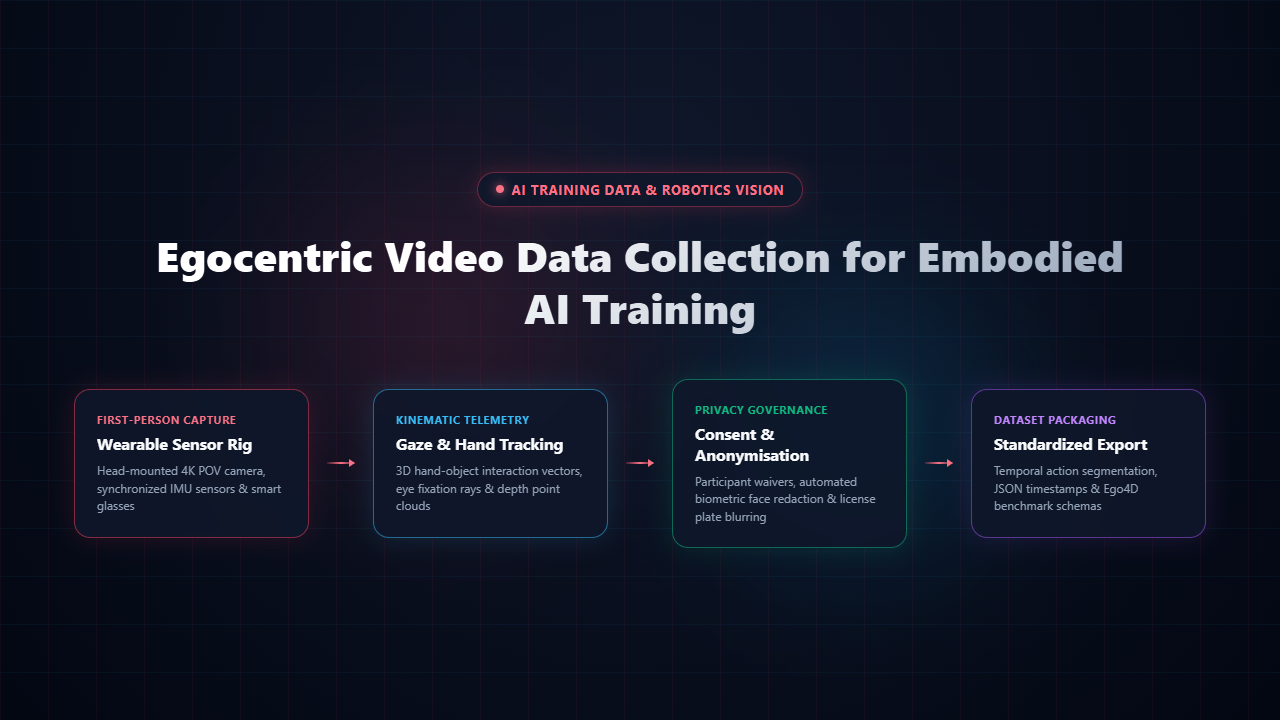
What Is Egocentric Video Data Collection for AI Training?
A technical overview of first-person video capture for artificial intelligence: wearable setups, hand-object interaction modeling, robotics training, and privacy compliance.
Computer Vision & Data Operations