
What Is Egocentric Video Data Collection for AI Training?
A technical overview of first-person video capture for artificial intelligence: wearable setups, hand-object interaction modeling, robotics training, and privacy compliance.
Editorial Team
Computer Vision & Data Operations
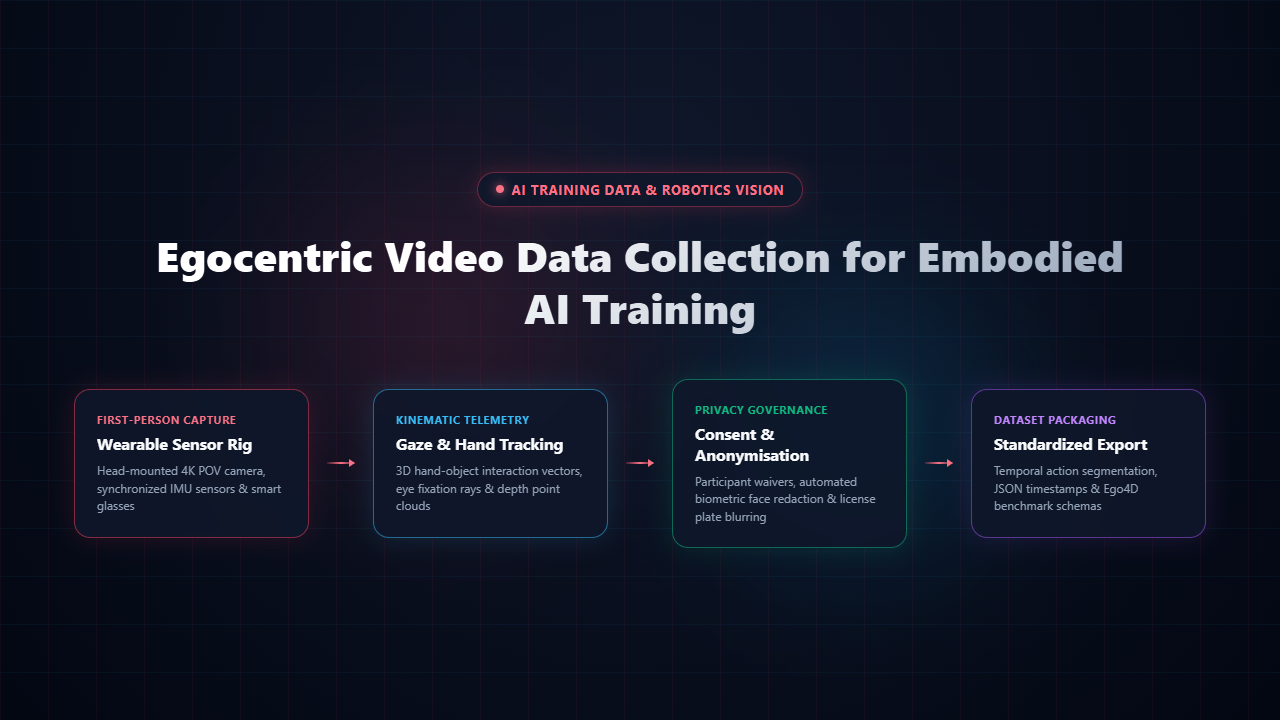
In the field of computer vision and robotics, traditional video datasets are primarily exocentric (third-person)—captured by fixed security cameras, tripods, or external handheld observers. While third-person video is suitable for tasks like perimeter security or sports analytics, it fails to capture how humans perceive and manipulate the physical world.
This limitation has driven explosive demand for egocentric video data collection—recording continuous, synchronized video from a first-person perspective using wearable devices.
Why First-Person Video Is Essential for Modern AI
Training embodied AI systems—such as robotic manipulators, assistive AR glasses, and human-activity understanding models—requires learning directly from human demonstrations.
Key technical characteristics of egocentric video include:
- Direct Hand-Object Interaction (HOI): Wearable cameras capture the exact contact points, grasp postures, torque applications, and occlusion dynamics when humans use tools, assemble machinery, or handle fragile items.
- Visual Attention and Gaze Tracking: First-person cameras aligned with eye-tracking sensors record where a human looks before performing an action, providing training signals for action anticipation models.
- Continuous Motion & Dynamic Perspective: As the wearer moves their head and body, the camera experiences realistic motion blur, viewpoint rotation, and lighting transitions that mirror real-world robotic sensor conditions.
       [ WEARABLE SENSORS ]
  +--------------------------------+
  |  - Smart Glasses (Gaze / RGB)  |
  |  - Chest Rig / Action Camera   |
  |  - IMU (Inertial Motion Units) |
  |  - Binaural Spatial Audio      |
  +--------------------------------+
                 |
                 v
     [ PROTOCOLIZED CAPTURE ]
  - Scripted & Unscripted Tasks
  - Diverse Environments & Lighting
  - Multi-User Demographic Coverage
                 |
                 v
     [ POST-PROCESSING & QC ]
  - Temporal Synchronization
  - PII Redaction (Faces, Plates)
  - Dense Action & Segmentation Annotations
Wearable Hardware Setups Used in Data Collection
Depending on the target AI research objective, collection teams utilize specialized recording hardware:
- Smart Glasses & Eye-Tracking Headsets: Capture head-mounted video along with dual eye cameras for pupil dilation and gaze vector coordinate logging.
- Chest & Harness Mounts: Provide stable torso perspective with reduced head-nodding vibration, ideal for dual-hand culinary, mechanical, or warehousing tasks.
- Synchronized IMU & Spatial Audio: Wearables equipped with 9-axis gyroscopes, accelerometers, and spatial microphone arrays to train audio-visual multimodal foundation models.
Rigorous Privacy, Anonymization, and Participant Consent
Because first-person cameras move through public and semi-private spaces, ethical compliance and data privacy are paramount:
- Explicit Participant Consent: All recording participants must sign IRB-compliant consent forms outlining dataset usage, model training scopes, and data retention policies.
- PII Redaction: Automated computer vision passes identify and blur bystander faces, license plates, computer monitor screens, credit card numbers, and proprietary brand labels.
- Environment Clearance: Capture protocols in commercial kitchens, manufacturing plants, or retail environments require verified property releases prior to sensor deployment.
Typical Applications of Egocentric Datasets
| Industry / Research Domain | Model Objective | Dataset Requirements |
|---|---|---|
| Robotics Manipulation | Imitation learning for robotic arms | High-FPS close-up hand grasps and tool manipulation |
| Augmented Reality (AR) | Context-aware user assistance | Egocentric gaze tracking, object detection in domestic scenes |
| Industrial Safety | Action recognition & compliance checks | First-person footage of safety gear usage and protocol adherence |
| Healthcare & Surgery | Procedural training & surgical robotics | First-person recording of sterile tool handoffs and microscopic tasks |
How The Serviceverse Executes Video Data Programs
At The Serviceverse, we design protocol-driven video collection campaigns with structured metadata, participant verification, and strict quality control.
To learn more about our hardware capabilities and capture workflows, visit our Video Data Collection and Video Annotation services, or contact our data operations team at info@theserviceverse.com.
Planning a Software, AI, or Data Initiative?
The Serviceverse helps engineering and product teams design scalable software architectures, train production computer vision models, and automate mission-critical operations.
Related Capabilities
Related Articles
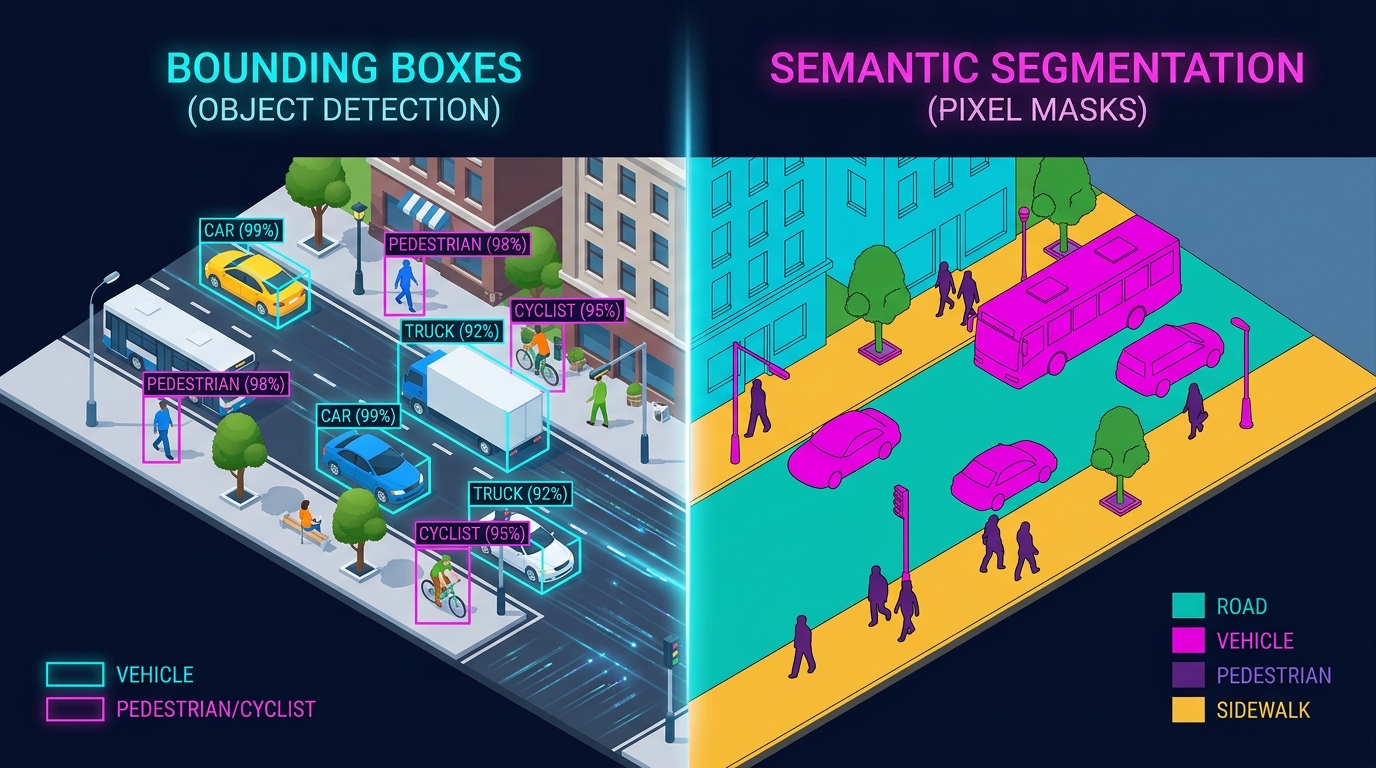
Image Annotation and Segmentation: Key Differences
A deep dive into bounding boxes, polygon masks, semantic segmentation, and instance segmentation: costs, labeler speed, and model training tradeoffs.
Computer Vision Annotation Lead